
Kgalagadi Transfrontier Park
Africa’s first Peace Park — 37,000 km² of red dune and salt pan, three-quarters of it in Botswana.
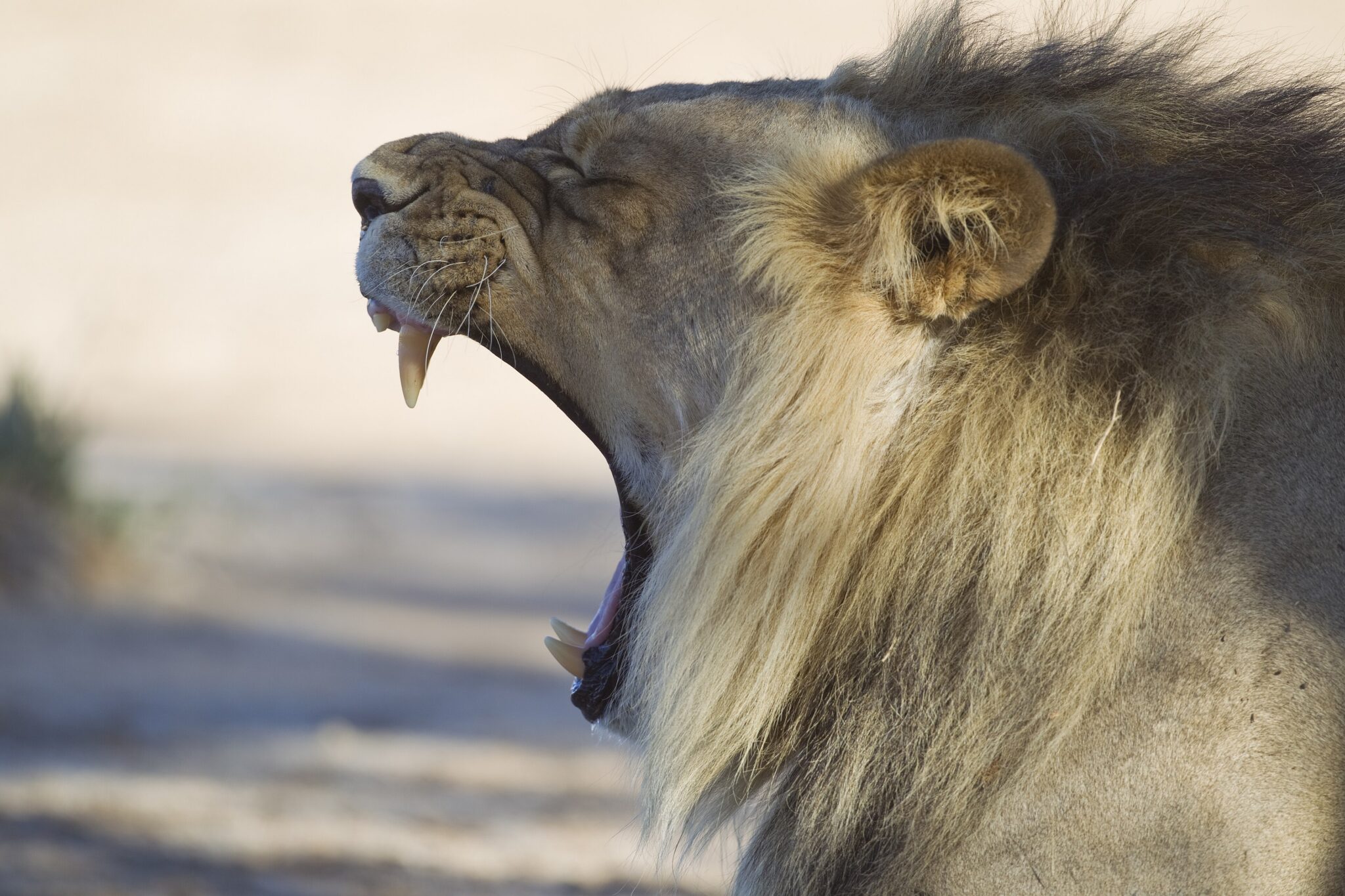
Kalahari regionAll parks and reservesA male lion yawning in the Kgalagadi Transfrontier Park, photographed in January 2012. Photo: Yathin S Krishnappa, CC BY-SA 3.0, via Wikimedia Commons.
The Kgalagadi Transfrontier Park is the hardest place in this guide to reach and, for a certain kind of traveller, the most rewarding. It is Africa’s first Peace Park, three-quarters of it lies in Botswana, and the Botswana side asks more of you than any other protected area in the country.
- Where
- The far south-west, against South Africa and Namibia
- Area
- 37,000 km² across both countries
- Botswana share
- About three-quarters of the park
- Treaty signed
- 1999; officially opened May 2002
- Formed from
- Botswana’s Gemsbok NP and South Africa’s Kalahari Gemsbok NP
- Botswana section
- Mabuasehube, a series of huge pans
- Vehicle
- Well-equipped 4×4 only, minimum two vehicles
In this guide
- Africa’s first Peace Park
- Kgalagadi Transfrontier Park: the country
- Mabuasehube, the Botswana side
- Wildlife in the Kgalagadi Transfrontier Park
- The convoy rule and what it means
- Gates and crossing between countries
- Which side should you visit?
- Best time to visit the Kgalagadi Transfrontier Park
Africa’s first Peace Park
In 1999 Botswana and South Africa signed a treaty forming the first transfrontier conservation area in Africa, and the Kgalagadi Transfrontier Park officially opened in May 2002. It merged Botswana’s Gemsbok National Park with South Africa’s Kalahari Gemsbok National Park into a single jointly managed protected area of 37,000 km².
The important word is unfenced. Botswana Tourism describes the Kgalagadi Transfrontier Park as completely unfenced, allowing wildlife to move freely along ancient migration routes. The international boundary runs along the dry bed of the Nossob River, and the animals do not observe it.
Three-quarters of the park lies inside Botswana, which is worth stating because most published photography and most visitor traffic comes from the South African side. The Botswana share is the larger, emptier and considerably harder part.
Kgalagadi Transfrontier Park: dunes, fossil rivers and pans
Botswana Tourism describes fossil river valleys dotted with dwarf trees and bushes, grasslands, and dunes of many colours. That last phrase is not decoration: the red of the southern Kalahari changes through the day and between dune faces, and it is a large part of why photographers rate this park so highly.
The dry Nossob riverbed is the organising feature. It carries no water in any normal year, but it holds the road, the boreholes and much of the game viewing on the South African side, and it marks the border.
Mabuasehube, the Botswana side
Mabuasehube is the north-eastern section, and it is what most Botswana-side visitors actually come for. Botswana Tourism describes it as a series of huge pans, and notes that the Mabuasehube pan floor is bare clay rich in salts, which attracts animals that come to lick the surface.
That single detail explains the game viewing here. The animals are not coming to water, because there is none; they are coming to the mineral surface itself. Campsites at Mabuasehube sit on the pan edges, unfenced, and the experience is closer to sleeping in the Kalahari than to visiting a park.
Wildlife in the Kgalagadi Transfrontier Park
The Kgalagadi Transfrontier Park holds several antelope species, with springbok and gemsbok everywhere, and Botswana Tourism singles out the famous black-maned Kalahari lion. Over 170 bird species are recorded.
Gemsbok gave both founding parks their names, and they remain the animal this landscape is built around: they handle heat and distance from water better than almost anything else and are visible on the open pans when little else is.
Birding is the quieter case for the Kgalagadi Transfrontier Park. Over 170 species are recorded, and the open country makes them unusually easy to work: raptors on the camelthorns along the dry riverbeds, sociable weaver colonies weighing down whole trees, and the small desert species that are hard to pick up in thicker bush further north. For anyone who finds a fourth lion sighting less interesting than a first pygmy falcon, this is among the best parks in the country.
The lions are the draw. Kalahari lions are described as larger-maned and darker than their northern counterparts, and seeing one on a red dune is the image this park trades on. As everywhere, sightings are not owed to anyone.
The convoy rule and what it means
Botswana Tourism states it plainly: self-drive campers must travel in a convoy of a minimum of two vehicles, using well-equipped 4×4 vehicles only.
This is not advice, it is a stated condition of self-driving here, and it is the single biggest planning constraint in this guide. A solo vehicle cannot lawfully do the Botswana side on the tourism authority’s own account. If you are one car, you need to find a second, book through an operator, or choose a different park.
The reasoning is distance rather than bureaucracy. This is deep sand across long stretches with no fuel, no water and, in much of the Botswana section, no realistic prospect of another vehicle passing. Recovery here is measured in days.
What well-equipped means in practice — recovery gear, tyres, water, range — is set out on our 4×4 and vehicle requirements page. Treat the Kgalagadi Transfrontier Park as the most demanding case it describes rather than a typical one.
Gates and crossing between countries
Botswana Tourism names Two Rivers, the Twee Rivieren gate, as the main entry and departure point between the two countries, with camping, chalets, shops and a restaurant.
Because the Kgalagadi Transfrontier Park spans an international border, moving between the two halves is a border crossing with the usual documentation, even though you never leave the protected area. Confirm current arrangements before you rely on crossing inside the park, and read Botswana entry requirements for the Botswana side.
Which side of the Kgalagadi Transfrontier Park should you visit?
This is the decision most people get wrong, because the two halves of one park offer genuinely different trips.
The South African side carries most of the traffic and most of the infrastructure. The Nossob road, the rest camps and the waterholes are there, sightings are more predictable, and a normal high-clearance vehicle can manage the main routes. It is the sensible first visit and the one most photography comes from.
The Botswana side is three-quarters of the park and a fraction of the visitors. Mabuasehube’s pan-edge campsites are unfenced and largely unserviced, the tracks are deep sand, and the convoy requirement applies. What you get for that is something close to solitude in a major park, which is increasingly rare anywhere in Africa.
Two Rivers, the Twee Rivieren gate, is where the two connect, and it is the only place in the park with camping, chalets, shops and a restaurant together. If you want both halves in one trip, plan the crossing there and treat it as an international border, because it is one.
The honest recommendation: if this is your first Kalahari trip and you are one vehicle, do the South African side. If you are two properly equipped vehicles and you have done sand before, Mabuasehube is the reason people come back.
Best time to visit the Kgalagadi Transfrontier Park
The southern Kalahari is the driest corner of Botswana — the tourism authority puts mean annual rainfall in the extreme south-west of the Kgalagadi District at under 250 mm, against over 650 mm in the far north-east.
Winter, May to August, brings cold nights and clear air, with animals concentrated near what water there is. Summer is very hot, with shade temperatures reaching 38 °C and above and occasionally 44 °C, but rain brings grass to the pans and the game with it. Neither is wrong; both are hard. The national picture is on best time to visit Botswana.
Official sources
- Botswana Tourism Organisation — Kgalagadi Transfrontier Park (1999 treaty and May 2002 opening, 37,000 km², the two founding parks, unfenced status, Nossob boundary and the Botswana three-quarters, Mabuasehube pans and salt lick, wildlife and black-maned lion, 170 bird species, Two Rivers gate, convoy and 4×4 rule)
- Botswana Tourism Organisation — Climate (rainfall range and temperatures)
Reviewed August 2026. Gate arrangements, convoy rules and cross-border procedures change; confirm with the park authorities before you travel, and if something here is out of date, tell us.
Plan the rest of your trip
This park asks more than any other in Botswana. These are the pages to read before committing to it.
The convoy rule, recovery gear and what deep sand actually demands.
Open →Central Kalahari Game ReserveThe other great Kalahari reserve, and a more forgiving introduction to sand.
Open →The KalahariThe wider region, and how the reserves and towns fit together.
Open →Two vehicles, or another park.
The convoy rule is the honest gate on the Kgalagadi Transfrontier Park. Plan around it early, not at the boundary.
Vehicle requirementsAll parks and reserves