
Chobe & Kasane
The far north on the Chobe River: the most accessible of Botswana’s great wildlife areas, with three international borders within an hour.
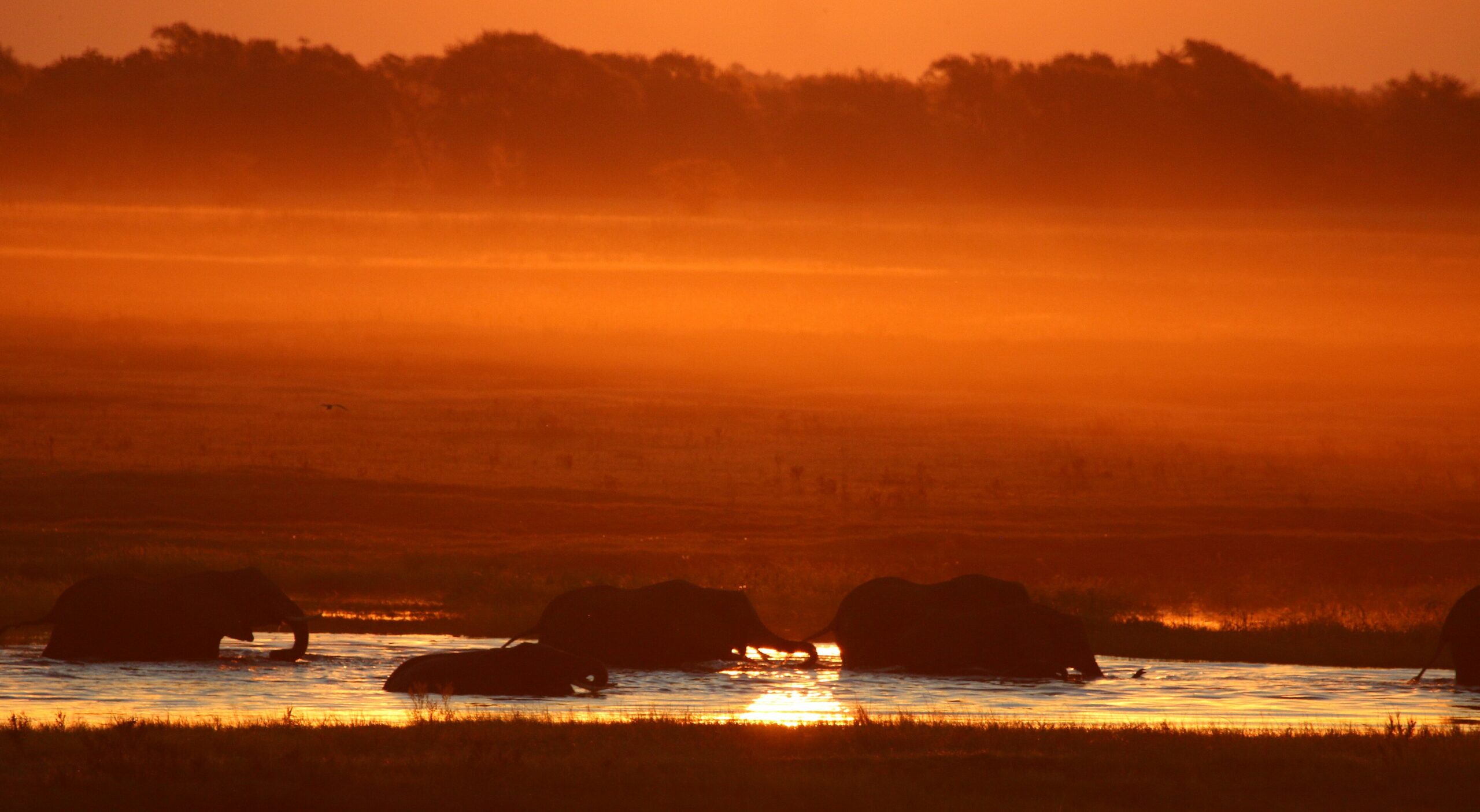
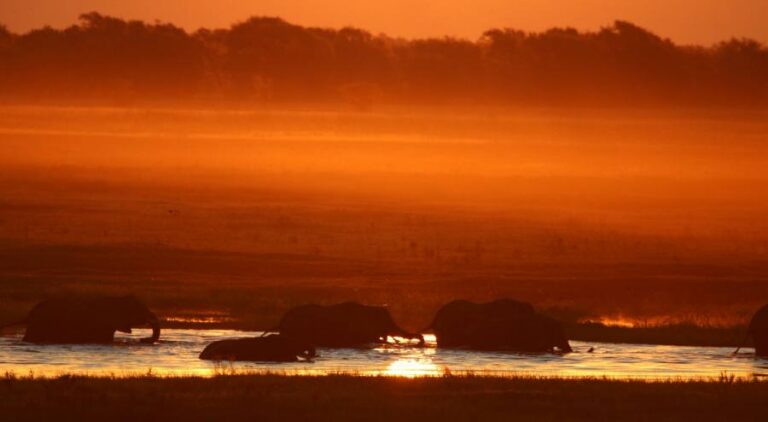
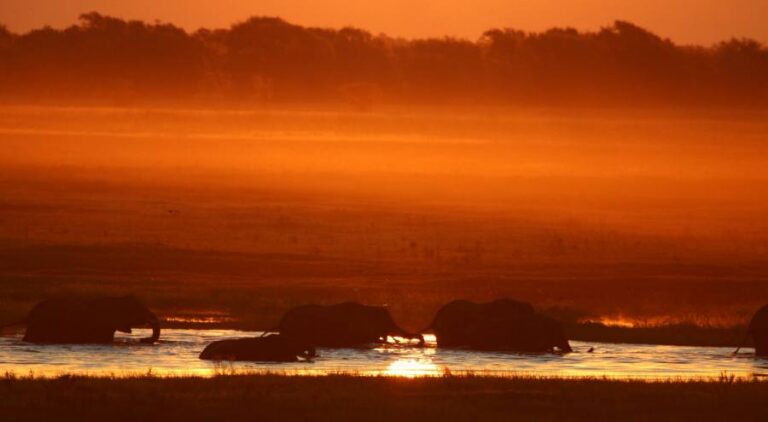
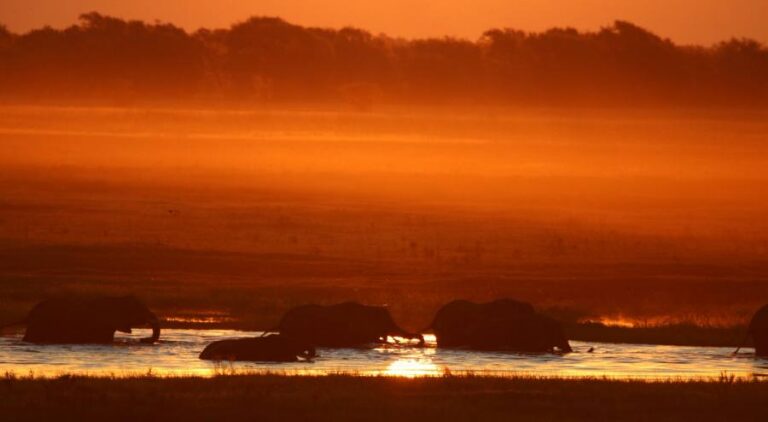
Chobe National ParkWhere to stayElephants silhouetted at sunset on the Chobe River, northern Botswana. Photo: NikSimpson, CC BY-SA 4.0, via Wikimedia Commons.
Chobe is the most accessible of Botswana’s great wildlife areas, and the one where the season changes the experience most. This Chobe National Park travel guide covers the park’s four sections, Kasane and its three international crossings, the dry-season elephant concentrations the region is famous for, and what self-drivers can take on.
Why visit Chobe and Kasane
Chobe National Park was established in 1968 and covers around 11,700 km² according to Botswana Tourism, with the Chobe River as its northern boundary. It is known for the largest elephant concentrations in the country and buffalo herds massing on the riverbank in the dry months. It holds puku, an antelope essentially confined in Botswana to this area, and 460+ bird species including Pel’s fishing owl.
The 2022 KAZA Elephant Survey estimated 227,900 elephants across the Kavango–Zambezi landscape, of which Botswana held 131,909, about 58%. The trend is contested: Elephants Without Borders found northern Botswana essentially unchanged over 2010–2022, growing around 1% a year, against government figures nearer 6%. Our wildlife section has more.
The four sections of the park
People say “Chobe” and mean the riverfront, but the park has four recognised sections.
Chobe Riverfront (Serondela)
The north-eastern section, reached from Kasane through Sedudu Gate, 10 km from town. It is the most accessible part of the park, seen by vehicle and by boat, where the dry-season elephant and buffalo concentrations occur — and the busiest.
Savuti (Savuté)
The south-western section, centred on the Savuti Marsh and Channel. The channel runs roughly 100 km from the Linyanti River into the marsh and the Mababe Depression, and over the past century has dried up and resumed flowing several times, killing stands of trees and later regenerating them. Savuti is open country, deep sand and, in the right season, exceptional predator viewing.
Linyanti
The remote north-western section, on the Linyanti Swamps fed by the Kwando River, which rises in Angola; sitatunga occur here. Just outside the park sit the private Linyanti, Selinda and Kwando concessions — Botswana Tourism gives Selinda as around 1,350 km² and Linyanti around 1,250 km² — where camps are small, fly-in and closed to self-drive. Government campsites are inside the park, not the concessions.
Nogatsaa and Ngwezumba
The central and southern pans country: undeveloped, little visited and genuinely wild, with game viewing that depends on whether the pans hold water; full self-sufficiency required.
Why Chobe in January looks nothing like Chobe in October
This is a mechanism, not a marketing line. Chobe sits in Botswana’s wettest corner: Kasane averages around 160 mm of rain in January and effectively none from June to August.
As inland pans dry out from roughly June, elephants and buffalo are forced onto the permanent water of the Chobe and Linyanti rivers, and concentrations peak in September and October. October is also the hottest month, averaging around 36 °C at Kasane, which pins animals to water harder still. Once the rains break they disperse widely inland, including into Zimbabwe and Namibia, and the riverfront empties by comparison. Chobe in January is green, thickly grassed, full of newborn antelope and migrant birds, and much harder work for large mammals. Neither is better; they are different trips.
The Savuti lions and elephants — what the research says
Savuti’s reputation for lions killing elephants is real, peer-reviewed and routinely oversold. The primary study, published in African Zoology in 2009 and building on observations from 1993–1996, found predation on elephants increased in the late dry season, August to November, and became more frequent across 1985–2005. Victims were mostly elephants aged roughly four to eleven, young males especially, and a pride of around thirty lions was documented hunting this way.
Three caveats matter: the behaviour is seasonal and site-specific, arising where elephants were forced onto scarce water, and conditions have changed since, with the channel’s flow altering and the research not extending past 2005. Nobody can promise you this sighting — go for excellent dry-season predator viewing and treat the rest as a possibility.
Kasane — three borders within an hour
The Kazungula and Ngoma posts, and what each one connects to, are listed in our entry requirements guide.
Kasane (9,095 at the 2022 census) is small, and its significance is positional: Botswana Tourism calls it the gateway to Chobe, and four countries sit within about an hour of it. The town itself — what it has, where to base, how long to stay — is covered on Kasane.
- Kazungula, for Zambia. The Kazungula Bridge opened on 10 May 2021, replacing the pontoon ferry that had served the crossing for decades. It carries a one-stop border post combining both countries’ checks. Anything still describing a Kazungula ferry is out of date — including Botswana Tourism’s own ports-of-entry table, so treat every opening time on it as unverified.
- Kazungula Road, for Zimbabwe. A separate crossing beside the bridge, and the route from Kasane to Victoria Falls town — Botswana Tourism gives the distance as 80 km. Day trips are a fixture of Kasane itineraries, but this is an international crossing with visa and vehicle documentation implications; check current requirements.
- Ngoma, for Namibia. On the Chobe River, connecting to Namibia’s B8 in the Zambezi Region. The A33 starts here and runs 65 km east through northern Chobe National Park to Kazungula; whether park fees apply to through traffic could not be confirmed officially, so ask at the gate.
Kasane Airport, 4 km south of town, is served by Air Botswana from Gaborone and Airlink from Johannesburg, with charter transfers to Linyanti, Savuti and the Okavango; road transfers from Victoria Falls are commonplace. See our destinations index.
The Chobe Enclave and community land
West of the park, between it and the river, lies the Chobe Enclave — not a park but community-held land with five villages: Mabele, Kavimba, Kachikau, Satau and Parakarungu. The Chobe Enclave Conservation Trust, initiated in 1993 and formalised in 1994, was Botswana’s first community-based natural resource management trust. For visitors it is the land between Ngoma and Savuti, and the setting for riverfront lodges.
Its finances show how community conservation works here. Before 2014 revenue came chiefly from hunting quotas, and income rose from around US$4,800 in 1993 to roughly US$700,000 in 2013. The 2014–2019 hunting moratorium removed that principal source, and since 2019 income has been limited to lease fees and lodge commissions. Researchers note a mismatch: benefits go to village projects while the costs of living with wildlife fall on households alone.
Activities
- Boat cruises on the Chobe River — the defining activity, and the best way to see elephant, buffalo, hippo and waterbirds at close range, with specialist photographic boats alongside larger sunset cruises.
- Game drives on the riverfront, guided or self-driven.
- Game drives in Savuti and Linyanti — open country and predators rather than river frontage.
- Birding and fishing, subject to current regulations; carmine bee-eater colonies broadly September–November.
- Mobile camping safaris linking Chobe with Moremi.
Night drives and walking safaris are not permitted inside the national park. They happen in the surrounding concessions and community areas — a good reason to spend part of a trip outside the boundary.
Access — getting there and getting around
Most visitors fly into Kasane, or arrive overland from Victoria Falls or Livingstone. By road, the A33 runs about 300 km of tar south from Kazungula to Nata, the junction most northern itineraries pass through; Francistown–Kasane is roughly 480 km and Maun–Kasane about 600 km of tar via Nata. The short direct line between Maun and Chobe through Moremi and Savuti is not a road but a demanding 4×4 track.
That track is the first to close when rain and the Okavango flood coincide: in 2026 it was shut by flooding around Khwai and Moremi reopened only on 13 April, with routes still restricted. Check route and gate status immediately before travelling and build in buffer days; our itineraries section covers the fly-one-way, drive-the-other approach.
On park fees we set out the structure, not amounts. Entry is per person per day, banded by residency, with parks in two categories — Chobe in the higher one — and a lower tariff for tour operators’ clients. Vehicle fees are separate and daily, banded by weight, registration and use; camping is separate again, per person per night. Entry fees go to the wildlife department, while campsites are booked with it or a concessionaire. An increase proposed for April 2026 was postponed, so confirm current fees before travelling.
Self-drive: what is and is not driveable
- The riverfront is the easiest serious game-viewing self-drive in Botswana: a short run from Kasane through Sedudu Gate, manageable as day trips, though 4×4 is required and sand is soft in places.
- Savuti and the Mababe route are a different proposition — deep sand over long distances, with no fuel, supplies or reliable signal.
- The Linyanti, Selinda and Kwando concessions are closed to self-drive — you visit as a booked guest, by air.
Inside the park the speed limit is 40 km/h and you must stay on established tracks. Book campsites well ahead — a year for peak season is common advice — and note that entry fees are paid separately from campsite fees. Gate names and opening hours circulate widely without consistent official confirmation, so verify them. More on our self-drive pages and parks index.
Accommodation context
By kind: safari lodges and lodges along the riverfront, tented camps inland, and guesthouses in Kasane town.
Kasane and Kazungula hold northern Botswana’s densest concentration of lodges, hotels and guesthouses, with houseboats a distinctive local option. Inside the park there are government campsites with basic facilities, plus private camps in the Savuti area. West of the park, lodges line the river in the Chobe Enclave, while the Linyanti, Selinda and Kwando concessions hold small all-inclusive fly-in camps. Mobile safari operators link Chobe with Moremi. We publish no rates or ratings; see our accommodation overview.
Best time to visit Chobe and Kasane
- July to October — the classic window, September and October peaking for riverfront elephant and buffalo. Hot, dry, busiest and most expensive.
- May and June — drying country, building concentrations, and minima of 9–12 °C that make a dawn cruise cold.
- November to March — green season: dispersed game, thick grass, newborn antelope, migrant birds and lower rates. Savuti and the pans can become impassable, while the riverfront stays workable.
Recent years have included both severe drought and an exceptionally high-water season, so treat these as tendencies and check conditions before booking.
Related planning pages in this Chobe National Park travel guide
- Chobe National Park and the parks and reserves index.
- Itineraries — combining Chobe with the Okavango.
- Travel planning — border crossings, entry requirements and money.
- Victoria Falls from Kasane — the day trip, the overnight option and the border reality.
- Self-drive, Maun to Kasane, camping in Botswana, accommodation, wildlife.
- Maun, the other northern gateway, and the destinations index.
- Two archives cover this region: accommodation in Kasane for the town itself, and accommodation across Chobe and Kasane for Kazungula and the riverfront lodges beyond it.
Where to stay in Chobe and Kasane
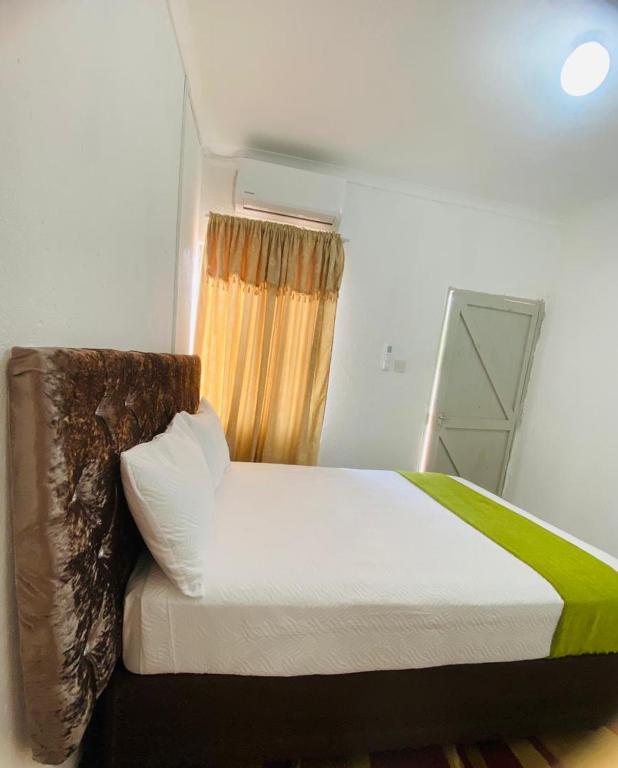
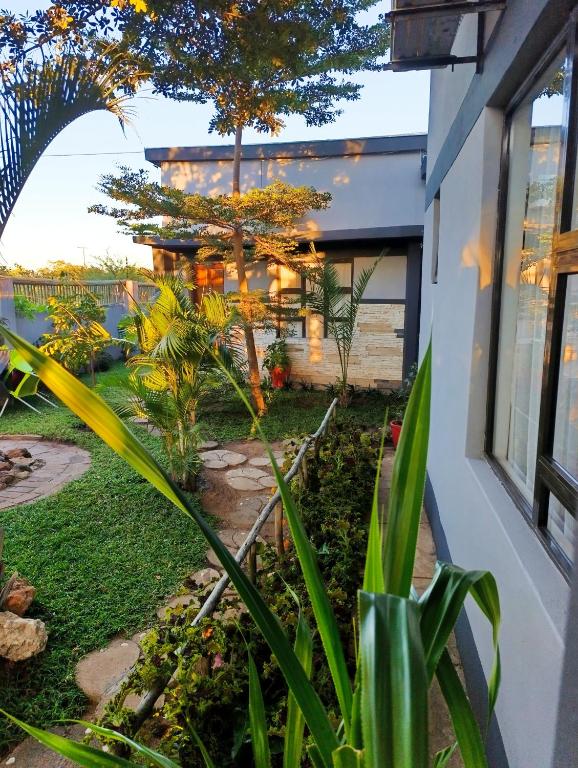
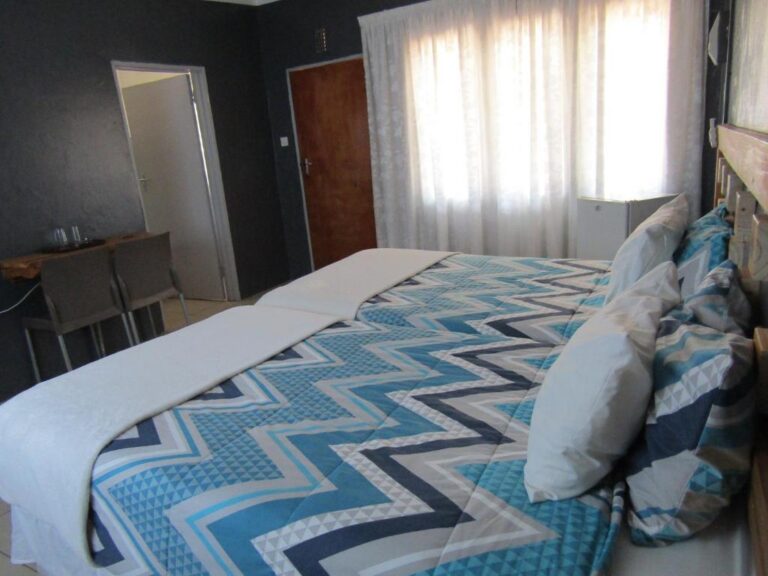
Riverfront lodges, town guesthouses and campsites we have checked, from the only lodge inside the park to a waterhole camp on the ridge.

View all 54 Chobe and Kasane propertiesAll Chobe and Kasane accommodation
Every card opens our own property page first. We publish no rates, no availability and no ratings of our own.
Tours you can book in Chobe and Kasane
Boat safaris on the Chobe, game drives into the park, and the day trips across the borders.

Every card opens our own tour page first. Booking happens on the operator’s site, where the live price and availability are.
Sources and references
- Botswana Tourism — Chobe National Park, Savuti and Linyanti, Kasane
- Botswana Tourism — ports of entry (partly outdated)
- Botswana Tourism — self-drive and climate
- Government of Botswana — park and campsite bookings and the 1992 Act
- SADC — Kazungula Bridge and One Stop Border Post
- KAZA Elephant Survey 2022 and Elephants Without Borders population trends
- Power & Compion, African Zoology — lion predation on elephants in the Savuti
- Ecology & Society — CBNRM and the Chobe Enclave
- ATTA — Moremi reopens, April 2026 and Botswana Daily News on the flood closure
Plan the rest of your trip
Chobe works as an opening or a closing act. These are the pages that decide which.
What the boat shows that the vehicle cannot, why the drive goes first, and the trips that do both.
Open →Francistown to KasaneThe A3 and A33 north: 480 km, the fuel decision at Nata, and the elephant stretch.
Open →Chobe National ParkThe riverfront, Savuti and Linyanti, and the rules that apply in each.
Open →Okavango Delta & MaunThe other half of the classic northern circuit, and how the two connect.
Open →Best time to visitWhy the north and the pans run on opposite calendars.
Open →Botswana 10 day itineraryThe two-region trip that finishes here, and the transfer options.
Open →Start with a region, or start with the month.
Chobe is easy to reach and hard to time badly — but the pans, a day’s drive south, are the opposite.
All destinationsPlan your tripBotswana and Victoria FallsThe 80 km border run from Kasane, honestly assessed — what it adds and what it costs.
Open →View all accommodation in Chobe and Kasane — every property we have published there, each with our own write-up before any booking route.