
Maun
Botswana’s tourism capital: the light-aircraft hub, the last full supermarket, and the road head for Moremi and the pans.
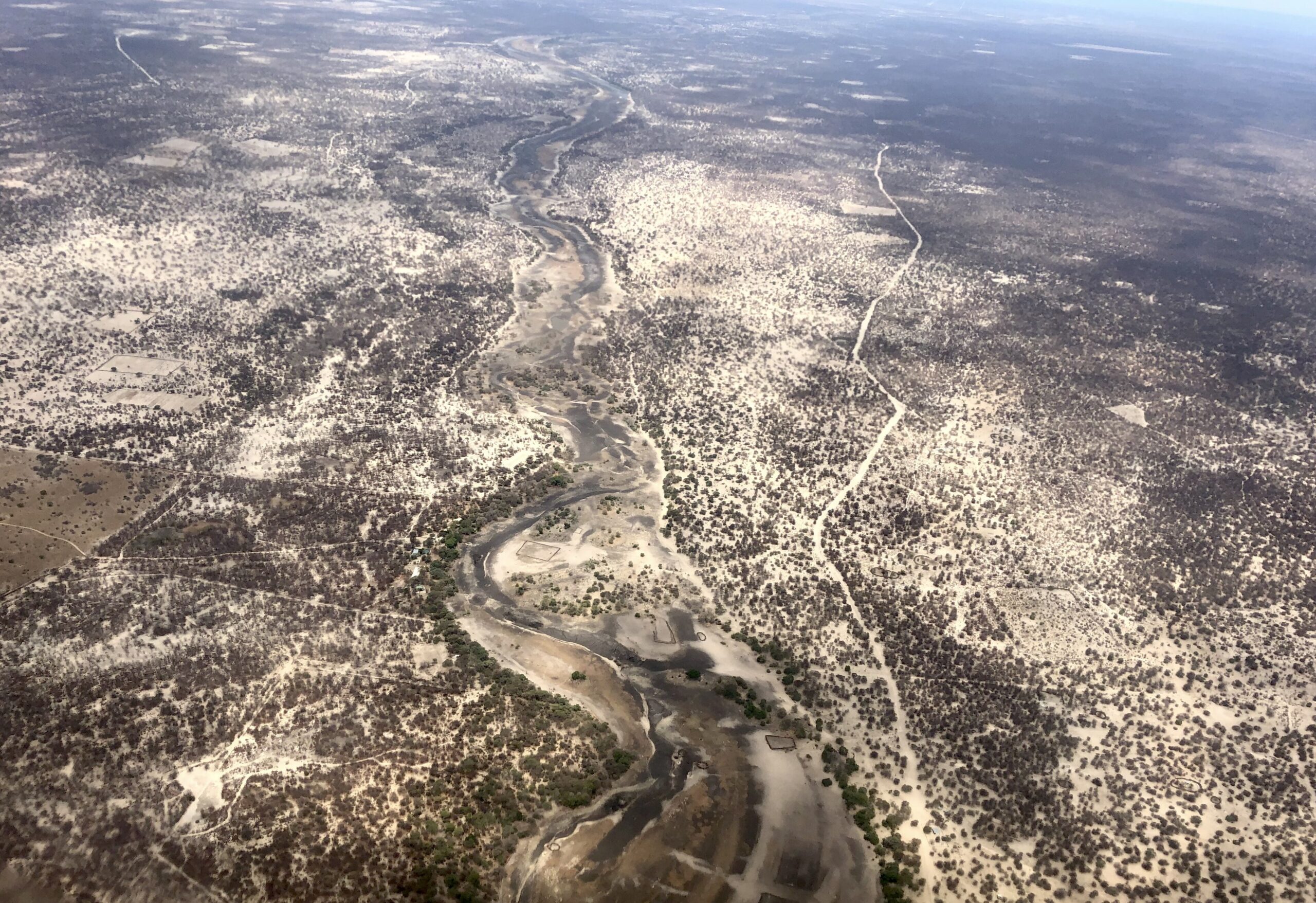
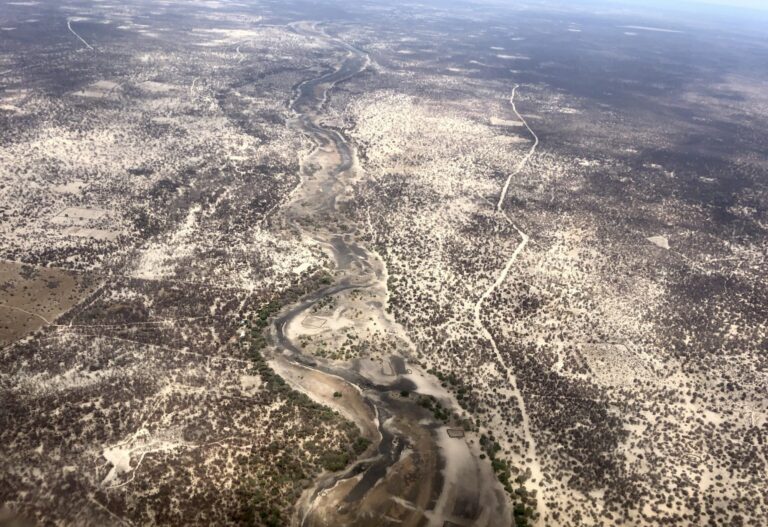
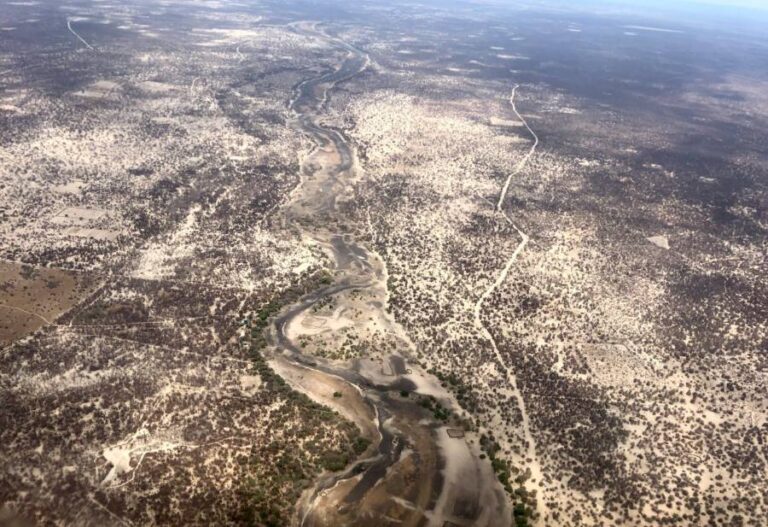
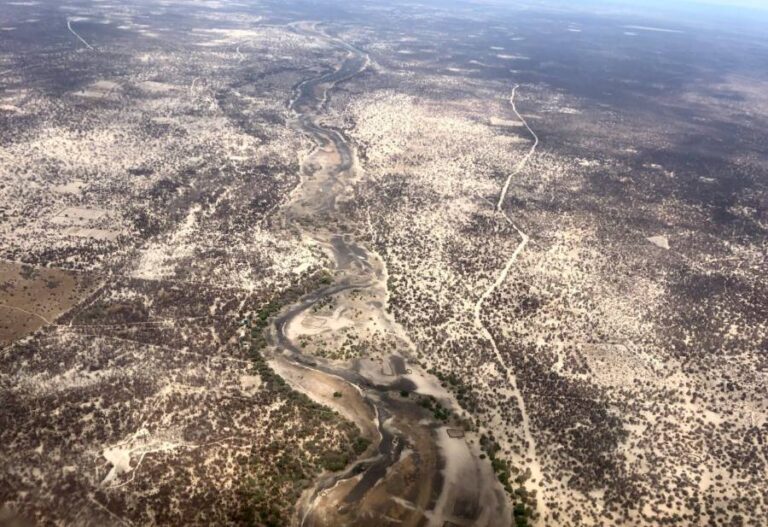
The Okavango Delta regionWhere to stayRiver channels seen from the air on the approach to Maun, Botswana. Photo: Adrian Michael, CC BY-SA 3.0, via Wikimedia Commons.
Maun is where most Botswana trips start, stop or change gear. It sits on the Thamalakane River at the southern edge of the Okavango Delta, and it is three things at once: a working town of nearly 85,000 people, the country’s busiest safari air hub, and the last reliable supermarket, bank and fuel stop before the tar runs out. This guide covers what Maun actually is, what you can reach from it, and how many nights it genuinely earns.
Maun at a glance
- Region: North-West District (Ngamiland East), southern rim of the Okavango Delta.
- What it is: Botswana’s main safari gateway, 84,993 people at the 2022 census; Botswana Tourism calls it the country’s tourism capital and the gateway into the Delta.
- Airport: Maun Airport (MUB), on the northern side of town, handling scheduled regional flights and a very large volume of charter traffic.
- Best for: arrival and departure nights, chartering into the Delta, hiring a 4×4, day trips to the Delta fringe.
- How long to stay: one to two nights either side of a camp or self-drive leg; three as a day-trip base.
- 4×4 needed? Not in Maun — the town and its approaches are tar. Yes, non-negotiably, for Moremi, Khwai, Nxai Pan and anything off the tar.
- Fuel: reliable, and one of the few dependable fuel points in northern Botswana. None inside the parks.
- Mobile signal: good in town. Botswana Tourism describes coverage as reaching major towns and parts of the highway only — assume nothing off the tar.
In this guide
- Why visit, and who it suits
- The town itself
- Maun as the light-aircraft hub
- Getting there and around
- Day trips and what you can reach
- Where to base yourself
- Where to stay
- How long to stay
- Nearby destinations
- Best time to visit
- Frequently asked questions
Why visit Maun, and who it suits
Almost nobody flies to Maun for Maun. It is a logistics town that happens to sit somewhere extraordinary, and it suits three kinds of traveller. Fly-in guests use it as a hinge: land from Johannesburg, cross to a light aircraft, be at camp within the hour. Self-drivers use it as the last staging post — vehicle, jerry cans, water, food, cash and campsite paperwork. Independent travellers on a smaller budget use it as a base, because it is the one place from which you can reach Delta water, Moremi and a mokoro trip without an all-inclusive camp stay.
The town itself
Maun is not a scenic town — flat, spread out, organised around commerce — and the river redeems it. It grew as a district and cattle centre and became a safari town over the last half-century; both layers are visible. Malls, banks, ATMs, fuel stations and hire yards sit alongside an older pattern of homesteads, livestock and riverbank, and the town thins into bush within minutes.
The Thamalakane River runs through it, carrying water that fell on the Angolan highlands months earlier; government reporting has the flood typically reaching the Boro and Maun around mid-June. When it is flowing there are hippo and crocodile in it, close enough that riverside lodges warn guests about the bank after dark; in a weak year stretches can be dry. Maun also holds the region’s vehicle-hire operators, safari and charter offices, a hospital, and a Department of Wildlife and National Parks office where park fees can be pre-paid — useful, since gate payment has historically been cash in pula.
Maun as the light-aircraft hub
Nearly every Okavango Delta and Linyanti camp is reached by light aircraft from Maun, landing on an unsealed strip near the camp. The aircraft are typically Cessna Caravan-class, twelve seats or fewer; a hop to a Khwai-area strip runs to roughly half an hour. Itineraries are stitched together by successive short flights, which is why a Delta trip can take in three camps with no driveable track between them.
Charter operators serving the Delta from Maun include Mack Air, Wilderness Air and Moremi Air. Movements are so numerous in the June to August peak that Maun Airport is widely described as the second-busiest in Africa for aircraft movements in those months — a claim resting on secondary sources rather than an aviation authority, so treat it as an indication of scale, not a verified ranking.
The 12 kg soft-bag limit
Botswana Tourism states baggage limits of 20 kg for domestic and international flights and 12 kg for light aircraft operations. Operators also require soft-sided bags with no rigid frame or wheels, because the pod lockers are narrow — industry practice rather than a published rule, so confirm the allowance with your operator and ask whether camera gear counts. Lodges and agents in Maun normally store the rest of your luggage while you are at camp.
Getting there and getting around
The standard routing is via Johannesburg, with Airlink and Air Botswana both flying Johannesburg–Maun and bypassing Gaborone. Airlink has also operated Cape Town–Maun; Air Botswana links Maun with Gaborone, Francistown and Kasane. Frequencies are not published as a static timetable, so check with the airline. Maun is a port of entry, though its published immigration hours look narrower than the airport’s working day — worth confirming on an unusual routing.
By road, everything runs on the A3. Francistown to Maun is about 480 km of tar via Nata, Maun to Kasane about 600 km, also via Nata, and Maun to Ghanzi about 325 km west; these are sums of published segment figures, good to within 10 to 20 km. The short direct line north through Moremi and Savuti is a demanding 4×4 track rather than a road, and the first thing to close when rain and flood coincide — it was shut through much of the 2026 wet season, Moremi reopening only on 13 April 2026 with routes still restricted. Check route and gate status immediately before travelling.
Within Maun distances are short but not walkable in the heat: lodges run transfers and the hire yards are within a few kilometres. More in our self-drive section.
Day trips and what you can reach
- Mokoro trips on the Delta fringe — poled through shallow channels from a station on the Boro or nearby, and entirely water-dependent: availability follows the flood at that spot, not the calendar.
- Moremi Game Reserve — South Gate (Maqwee) is about 92 km from Maun, making a long day trip possible in a 4×4 but a poor use of the reserve.
- Khwai (NG19) — the community concession bordering Moremi, commonly self-driven from Maun, where night drives and walking are permitted because it sits outside the reserve.
- Scenic flights by light aircraft or helicopter — the one way to grasp the shape of the fan.
- Nxai Pan National Park — the entrance is roughly 130 km east with tar to the gate, though 4×4 is essential inside; Baines’ Baobabs lie some 30 km further in.
Where to base yourself
In town suits short turnarounds, early charter departures and self-drivers with provisioning to do: near the airport, malls, hire yards and fuel, and the least atmospheric of the three.
Thamalakane riverside is where most visitors are happiest — lodges and guesthouses along the river on either side of town, with frontage, birdlife and cooler evenings, still a short drive from the airport.
Out towards the Delta, along the Boro and Shorobe roads, puts you closer to the water and further from services. It suits several days of Delta-edge activity rather than a single overnight; check road conditions in the wet season.
The first night and the last night are not the same problem
Most people who sleep in Maun do it twice — once on the way in and once on the way out — and the two nights want different things.
The first night is about arriving. International connections land in the afternoon, transfers take longer than the map suggests, and you are usually still carrying whatever luggage you flew with. Somewhere close to the airport with parking and a kitchen that serves late is worth more than a view you will see for forty minutes in the dark.
The last night is about leaving. Light-aircraft departures for the camps go early, and the 12 kg soft-bag limit described above means most people repack in Maun rather than at the airstrip. What matters is proximity to the airport, somewhere to leave the bag you are not taking into the Delta, and a property that understands a 6 a.m. start. If you are ending a self-drive instead, the priorities invert: you want the hire yard, a fuel station and somewhere to wash off a week of Kalahari dust.
Both are short stays, and both are worth booking rather than improvising — see every Maun property we have checked.
Where to stay
Maun’s accommodation runs from campsites and backpacker lodges through guesthouses to riverside lodges and a few larger hotels. Almost all of it is independent rather than chain, and much of it doubles as an activity operator.
Riverside properties are the characteristic Maun offering — Thamalakane River Lodge, north-east of town on the river, is one example of the type. We publish no rates, availability or ratings; our accommodation overview explains the categories.
Where to stay
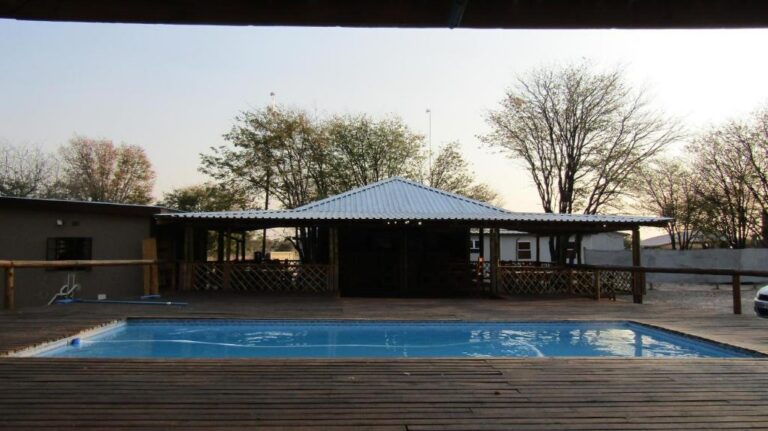
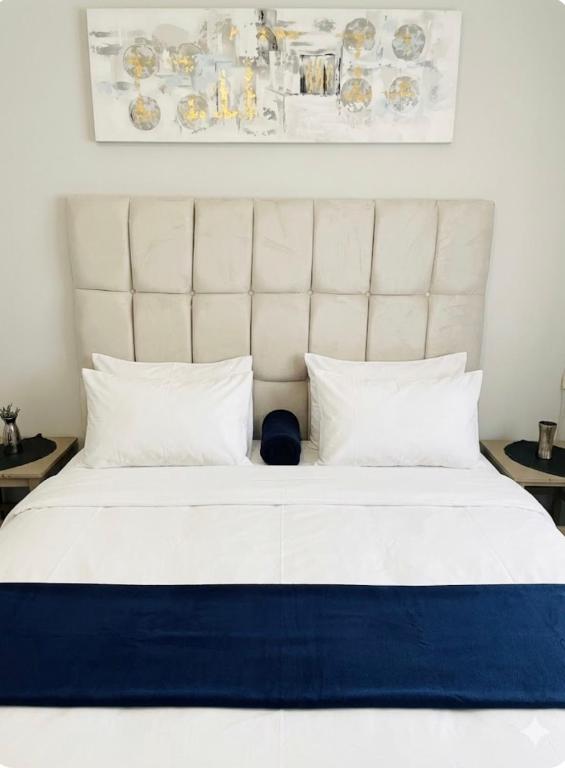
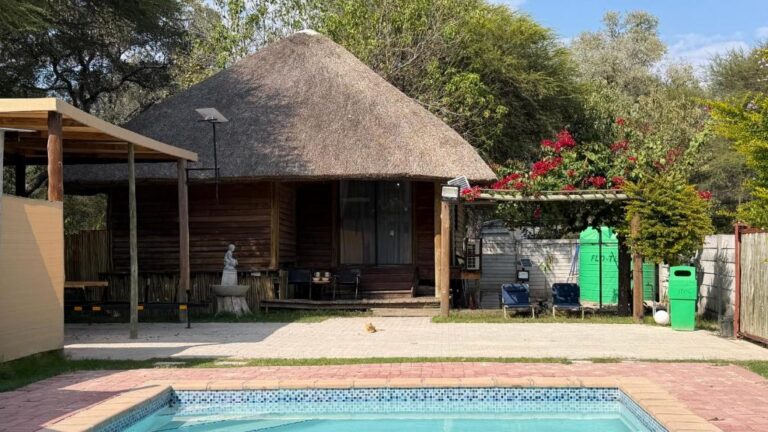

View all 76 Maun propertiesAll accommodation in Maun
Every card opens our own property page first. We publish no rates, no availability and no ratings of our own.
View all accommodation in Maun — 76 properties we have checked.
How long to stay
One night is enough if Maun is purely a transfer point, and given how tight international connections can be it is insurance rather than luxury — light aircraft do not wait.
Two nights is the sensible default: one on arrival, one on the way out, with a mokoro trip or scenic flight in between. Three or four makes sense only if you are using Maun as a budget base for Delta-edge day trips, or preparing a self-drive vehicle unhurried.
Nearby destinations
- The Okavango Delta — by air, by mokoro from the fringe, or by 4×4 into Moremi and Khwai.
- Nxai Pan and the Makgadikgadi — east on the A3, an easy addition to a Maun–Francistown drive.
- The panhandle and Tsodilo Hills — north-west up the A35 via Gumare to Shakawe.
- Chobe and Kasane — about 600 km of tar via Nata, or a short charter flight; flying one way and driving the other is the usual answer.
- Ghanzi — 325 km west, the start of the Trans-Kalahari route to Namibia.
Best time to visit
- June to September — dry, mild by day, and the window when the flood is high in the lower Delta. Minima of 9–12 °C make dawn cold. Busiest and dearest.
- October — the hottest month, averaging around 36 °C, and for that reason the year’s most concentrated game viewing.
- November to March — the green season. Maun’s rain falls chiefly now, roughly 80–105 mm a month at the peak, in afternoon thunderstorms rather than all-day drizzle. Antelope calve, migrant birds arrive, rates drop and road closures become a real planning risk.
- April and May — underrated: drying land, arriving flood, fewer people.
Treat this as a pattern, not a promise: recent seasons have included both severe drought and an exceptionally high-water year.
Frequently asked questions
Is it worth spending time in Maun, or should I fly straight out to a camp?
If your budget runs to camps, spend one night on arrival and fly out next morning — insurance against a delayed connection. If you are travelling independently, Maun is worth two or three nights.
Can I see the Okavango Delta on a day trip from Maun?
Yes, on the southern fringe: by road to a mokoro station, then by poled canoe. That is a real Delta experience, but it is the seasonal floodplain edge rather than the permanent swamp, and depends on water being there that season. A scenic flight is the other honest day option.
Do I need a 4×4 in Maun?
Not for the town, the airport or the tar approaches. You need a properly equipped 4×4 the moment you head for Moremi, Khwai, Nxai Pan or any campsite off the tar; Botswana Tourism advises carrying at least 100 litres of fuel and 20 litres of water per person in remote areas.
How far ahead should I book?
Camps and peak-season campsites go early — a year ahead is common advice for public campsites between June and October. There is no single reservations body: campsites are booked with the wildlife department or individual concessionaires, separately from park entry.
Where to stay
76 Maun properties are written up in our catalogue, from riverside lodges on the Thamalakane to town hotels and campsites. Four representative ones:
300 km of tar between two national parks, and where the fuel actually is.
Open →Namibia to Maun via GhanziThe western way in: the Mamuno border, the Trans-Kalahari and the stop at Ghanzi.
Open →A 24-room lodge on a private island reserve on the Thamalakane, about 10 km from the airport.
Open →A nine-unit owner-run guesthouse in a quiet garden plot off the Shorobe road.
Open →See all 76 Maun properties, or use the accommodation finder at the top of any page to search by property name. We publish no rates, no availability and no ratings of our own.
Tours you can book from Maun
Mokoro days on the delta channels, full-day Moremi drives and the multi-day camping safaris that start from town. Each links straight to the operator listing.
Tours you can book

Every card opens our own tour page first. Booking happens on the operator’s site, where the live price and availability are.
View all Maun and Okavango tours — 90 tours we have checked. We publish no prices, no availability and no ratings of our own.
Plan the rest of your trip
- Destinations index and the Okavango Delta region guide.
- Parks and reserves, including Moremi and Chobe National Park.
- The two activity decisions most Maun trips turn on: mokoro safaris in the Okavango Delta and Moremi day trip or multi-day safari.
- Self-drive — vehicles, fuel, campsites and route status — and Maun to Kasane, the tar route or the 4×4 crossing.
- Itineraries — how Maun, the Delta and Chobe fit together.
- Travel planning, camping in Botswana, accommodation in Maun and wildlife.
- By kind rather than by town: self-catering for parties re-provisioning between park legs, campsites along the Thamalakane, and hotels beside the airstrip.
Sources and references
- Botswana Tourism — Maun
- Statistics Botswana — Population of Cities, Towns and Villages 2022
- Botswana Tourism — entry formalities and baggage limits, self-drive and camping, communications and climate
- Botswana Tourism — ports of entry (contains outdated entries; verify hours)
- Air Botswana — destinations, Airlink — Johannesburg to Botswana and the Civil Aviation Authority of Botswana
- Government of Botswana — park and campsite bookings
- Botswana Daily News — the flood reaching Boro and Maun and ATTA — Moremi reopens with restricted access, April 2026
Continue planning
How the region fits together, and which parts of it you can actually drive.
Open →Moremi Game ReserveThe nearest big reserve, and what a self-drive day inside it involves.
Open →4×4 and vehicle requirementsWhat “properly equipped” means before you leave Maun.
Open →Botswana 7 day itineraryOne region done properly: Maun, Moremi and Khwai in six nights.
Open →Maun is the hinge, not the holiday.
Almost every northern itinerary passes through it. What matters is what you do before you leave.
The Okavango Delta regionWhere to stayView all accommodation in Maun — every property we have published there, each with our own write-up before any booking route.