
Moremi Game Reserve
The reserve on the Okavango’s eastern edge: a drivable half you can reach from Maun, and a water-bound half you cannot.
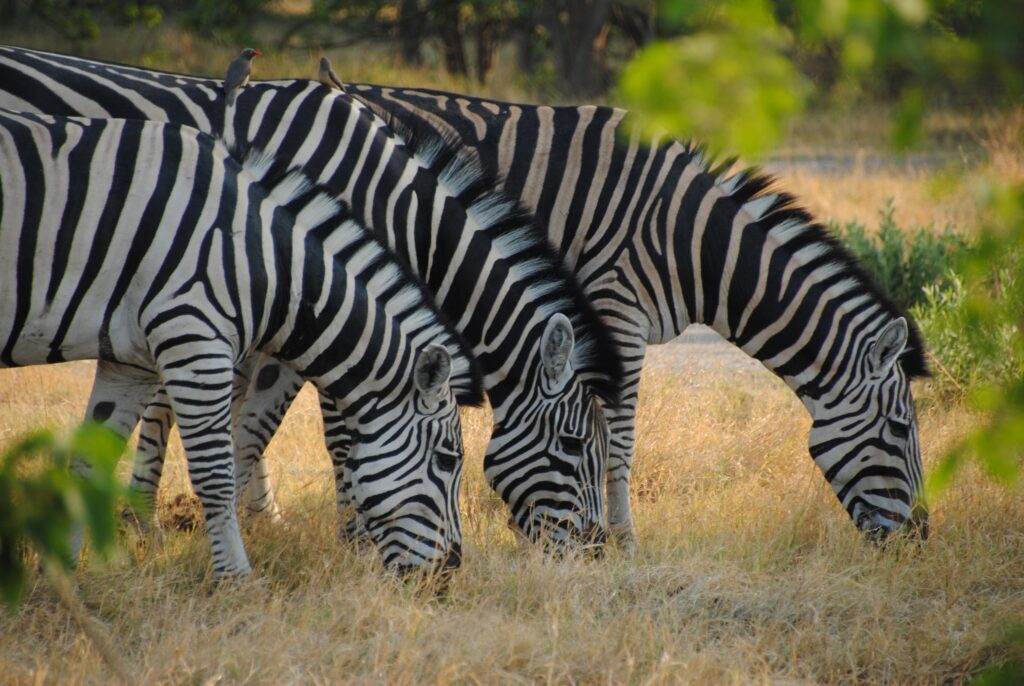
The Okavango Delta regionAll parks and reservesPlains zebra grazing in Moremi Game Reserve, Botswana. Photo: diego_cue, CC BY-SA 3.0, via Wikimedia Commons.
Moremi Game Reserve is the only part of the Okavango Delta anyone can drive into, and the only one whose founding story begins with a community rather than a government. It occupies the central and eastern Delta in Ngamiland, where floodplain, lagoon, mopane woodland and dry island meet. This guide covers the gates and tracks, the rules, and the 2026 flooding still shaping access.
Moremi Game Reserve at a glance
- Designation: game reserve, run by the Department of Wildlife and National Parks under the 1992 Act.
- Proclaimed: 1963, by the Batawana people, on their own land.
- Size: Botswana Tourism gives around 3,900 km²; other references around 5,000 km². We cannot reconcile the two. UNESCO puts roughly 40% of the Okavango Delta World Heritage property inside the reserve.
- Region: central and eastern Okavango Delta, North-West District.
- Gates: South Gate (Maqwee), about 92 km from Maun, and North Gate (Khwai).
- Self-drive: yes. 4×4: required, and under 5 tonnes for the pole bridges.
- Permitted: daytime driving on tracks at 40 km/h. Not permitted: night drives, walking safaris, off-road driving.
- Accommodation: public campsites at South Gate, Third Bridge, Xakanaxa and Khwai/North Gate, plus private camps.
- Best months: June to October; December to March brings birds, newborn antelope and a real risk of closure.
- Status warning: reopened 13 April 2026 with routes still restricted — read this before routing a trip.
In this guide
- Why go, and who it suits
- 1963: the tenure story
- Tongue, bridges and island
- Wildlife and what to expect
- Gates and getting there
- What is and is not permitted
- Camping, fees and booking
- The 2026 flooding and access
- Best time to visit
- Frequently asked questions
Why go, and who it suits
Most of the Okavango is leased concession land you may only enter as a booked guest of the camp holding the lease. Moremi is the exception: state land, open to anyone who pays the entry fee, with public campsites and a road network you drive yourself. That single fact makes it the hinge of independent travel in northern Botswana.
It suits self-drivers above all — the Maun–Moremi–Khwai–Savuti–Chobe run, or three or four nights out of Maun — and anyone wanting Delta habitat without a fly-in budget. It suits you less if you want night drives, walks or off-road tracking.
1963: the tenure story that makes Moremi Game Reserve different
Moremi was proclaimed in 1963 by the Batawana people, on their own land, three years before independence, in response to wildlife losses to uncontrolled hunting and cattle encroachment. It is named after Chief Moremi III.
Botswana Tourism calls it the first reserve in Africa established by a local community on its own ancestral land; the claim is more often written as the first in southern Africa. We cannot resolve which is correct, and it matters less than the substance: a community protected its own land decades before community-based natural resource management became national policy. Botswana’s trust and concession system came afterwards.
Tongue, bridges and island
The Mopane Tongue. The drivable body of the reserve is a peninsula of dry land pushing north-west into the Delta under mopane woodland — the Mopane Tongue or Moremi Tongue, one feature under two names. Nearly all self-drive routing happens on it: South Gate (Maqwee) at its base, Third Bridge and Xakanaxa at its tip, North Gate on its north-eastern flank.
Xakanaxa sits at the north-western end on its lagoon, where woodland gives out into permanent water — the best water frontage reachable by road, with heronries, boat access and a public campsite. The route to it crosses First, Second and Third Bridges, timber pole causeways rather than engineered structures, hence the 5-tonne limit. Third Bridge is the reserve’s known weak point, regularly damaged by rain and flood; the rustic campsite beside it, near the Sekiri River, is the best known in Botswana.
Khwai and North Gate form the north-eastern corner, on the Khwai River opposite the Khwai community area (NG19), and the link north to Savuti and Chobe. The riverine woodland here is the classic leopard habitat of the region. West of South Gate lies Chief’s Island, the Delta’s largest island and historically a Batawana hunting ground, inside the reserve boundary — but not part of the self-drive network, being reached by air and served by fly-in camps.
Wildlife and what to expect
Botswana Tourism credits the reserve with all significant naturally occurring herbivore and carnivore species of the region plus 400-plus bird species. Elephant, buffalo, lion, giraffe, zebra, red lechwe, tsessebe and hippo are present, and the mix depends on where the water is that season — our flood cycle page explains why.
African wild dog
Here the marketing and the science agree. The IUCN Red List assesses Lycaon pictus as Endangered — roughly 6,600 adults and yearlings globally, about 1,409 of them mature, figures IUCN itself calls imprecise — and names northern Botswana among the largest remaining populations. Moremi and Khwai are among the best places on Earth for the species, most reliably in the denning season in the dry winter months, when a pack is tied to a den. That is a probability, not a promise.
Leopard
Moremi and Khwai are the conventional leopard recommendation in Botswana, on sound reasoning: riverine woodland and high prey density. The caveat most guides omit is that sightings are better on the Khwai side because of access, not leopard density — Khwai permits off-road driving and night drives, and inside the reserve a leopard that leaves the track is one you stop watching. We found no robust published density figure for either area and will not quote one.
Rhino
Botswana Tourism’s page describes reintroduced rhino making Moremi a Big Five destination. Treat that as dated. Rhino returned to the Delta from 2001, were heavily poached from 2018, and in October 2021 government announced it would move the survivors to sanctuaries; whether free-roaming animals remain is unresolved. Do not travel here expecting rhino.
Gates and getting there
Two gates are in general visitor use. South Gate (Maqwee) is about 92 km from Maun — a long half-day in a loaded 4×4, not an hour’s drive, because the surface deteriorates well before the gate. North Gate (Khwai) links north to Savuti and Chobe. Fly-in guests bypass both, landing on bush airstrips under a 12 kg soft-bag limit for light aircraft.
For self-drivers, Maun is the last dependable fuel, cash and provisioning point — there is no fuel, no shop and no reliable signal inside the reserve. Botswana Tourism advises at least 100 litres of fuel and 20 litres of water per person in remote areas; see our 4×4 requirements and self-drive pages.
What is and is not permitted inside
- 40 km/h speed limit inside the reserve, per Botswana Tourism.
- Stay on established tracks — off-road driving is not permitted. An operator source reports a heavy fine for leaving the track; we cannot confirm the amount and do not publish it.
- No night driving, and no walking safaris — movement is daytime only, between gate hours, and you do not leave the vehicle except at designated points and campsites.
- Vehicles under 5 tonnes only, because of the pole bridges.
The contrast with Khwai (NG19) is the most useful thing to understand about this corner of Botswana. The community concession lies across the river from North Gate, and because it is outside the reserve, night drives and walking safaris are permitted there and off-road driving is at the concession’s discretion. It is also self-drivable, unlike almost every other concession, and is constantly confused with NG18, the camp-based Khwai Private Reserve next door. Split your time; our safaris and activities pages cover each.
Camping, fees and how booking works
Four public campsite areas sit inside the reserve — South Gate, Third Bridge, Xakanaxa and Khwai/North Gate — alongside private camps. There is no single national reservations body, and that is what catches people out: the wildlife department collects entry fees and runs some sites, while many others are managed by private concessionaires and booked separately. Names recurring across sources for Moremi are Kwalate Safaris (South Gate, Xakanaxa), Xomae (Third Bridge) and SKL Camps (Khwai/North Gate). Treat that allocation as unverified — concessions are re-tendered and our sources are third-party. Confirm who holds a site before sending money, and book far ahead.
We publish no fee amounts. The structure is stable even as figures change: parks fall into two categories, with Moremi in the higher one alongside Chobe; entry is per person per day, banded by citizen, resident and non-resident status; vehicle fees are separate and daily; camping separate again, per night. An increase proposed for 1 April 2026 was postponed the day before it was due. Confirm current fees with the wildlife department — gate payment has historically required cash in pula.
The 2026 flooding and current access
The 2025/26 wet season was exceptional and Moremi closed. A reopening planned for 27 March 2026 was postponed as rain continued, and mobile operators cancelled bookings. The reserve reopened on 13 April 2026 with restricted access, as reported at the time:
- Third Bridge — closed until further notice.
- Khwai to Xakanaxa — deemed inaccessible.
- Khwai to South Gate — difficult and potentially hazardous, for experienced off-road travellers only.
- South Gate to Xakanaxa — fair and manageable for smaller vehicles.
Operators were advised to build buffer time into itineraries. We cannot confirm what has changed since April 2026. Check status with the wildlife department or your campsite operator immediately before travelling, and treat the Maun–Moremi–Khwai–Chobe transit as provisional until you have. Rain from December to March and the Okavango flood from May to August close tracks by different mechanisms; in 2026 both arrived together.
Best time to visit
- June to September — the classic window: flood at or near its peak, game on permanent water, tracks at their best, wild dogs denning. Nights are cold, 9–12 °C at Maun. Busiest and dearest.
- October — the hottest month, around 36 °C at Maun, and for that reason the year’s most concentrated game viewing.
- November to March — the green season: thunderstorms, thick grass, dispersed animals, antelope births, migrant birds, lower rates. Closure is a real planning risk.
- April and May — drying land, arriving flood, fewer vehicles; underrated, though 2026 showed April can still be a recovery month.
Treat this as a pattern, not a promise: recent seasons have included both severe drought and an exceptionally high-water year.
Frequently asked questions
Can I self-drive in Moremi Game Reserve?
Yes, in a properly equipped 4×4 under 5 tonnes, with pre-booked campsites and full self-sufficiency in fuel, water and recovery gear. It is not a first 4×4 experience: sand, water crossings, pole bridges, no assistance.
Why can I do a night drive at Khwai but not in Moremi?
Because Khwai (NG19) is a community concession outside the reserve, and concessions set their own activity rules within their lease. Inside a game reserve, national rules apply. The animals do not know the difference; the regulations do.
Is Third Bridge open?
We cannot tell you. It was reported closed until further notice when the reserve reopened on 13 April 2026, and it is the structure most often damaged by flood in any year. Confirm before routing a trip through it.
Plan the rest of your trip
- Parks and reserves and Chobe National Park.
- The Okavango Delta and Maun, 92 km from South Gate.
- Self-drive — vehicles, fuel, campsite booking and route status.
- Itineraries — how Moremi, Khwai, Savuti and Chobe fit into one route.
- Wildlife and seasons, safaris and activities, accommodation and travel planning.
Official sources for Moremi Game Reserve
- Botswana Tourism — Moremi Game Reserve and Parks and Reserves
- UNESCO World Heritage Centre — Okavango Delta and Ramsar Site 879 — Okavango Delta System
- Wildlife Conservation and National Parks Act 1992 and the Government of Botswana on bookings
- Botswana Tourism — self-drive and camping and entry formalities
- ATTA — Moremi reopens with restricted access, April 2026 and Botswana Daily News on the closure
- IUCN Red List — African wild dog (Lycaon pictus) and the Environmental Investigation Agency on rhino poaching
- The 2026 park fee postponement and BIOFIN on fee reform
Plan the rest of your trip
Moremi is usually one half of a northern circuit. These are the pages that decide the other half.
The other great northern park, and how a week there differs.
Open →Okavango Delta & MaunThe region Moremi sits inside, and the town you reach it from.
Open →4×4 and vehicle requirementsWhat the sand tracks and water crossings actually demand.
Open →Botswana 7 day itineraryWhere Moremi and Khwai fit into a realistic first week.
Open →Two halves, one reserve.
Which half you see depends on the water, the month and the vehicle you arrive in.
All parks and reservesPlan your trip