
Botswana Travel Planning
Visas, money, health, connectivity, driving rules and the one question that decides everything else: which month.
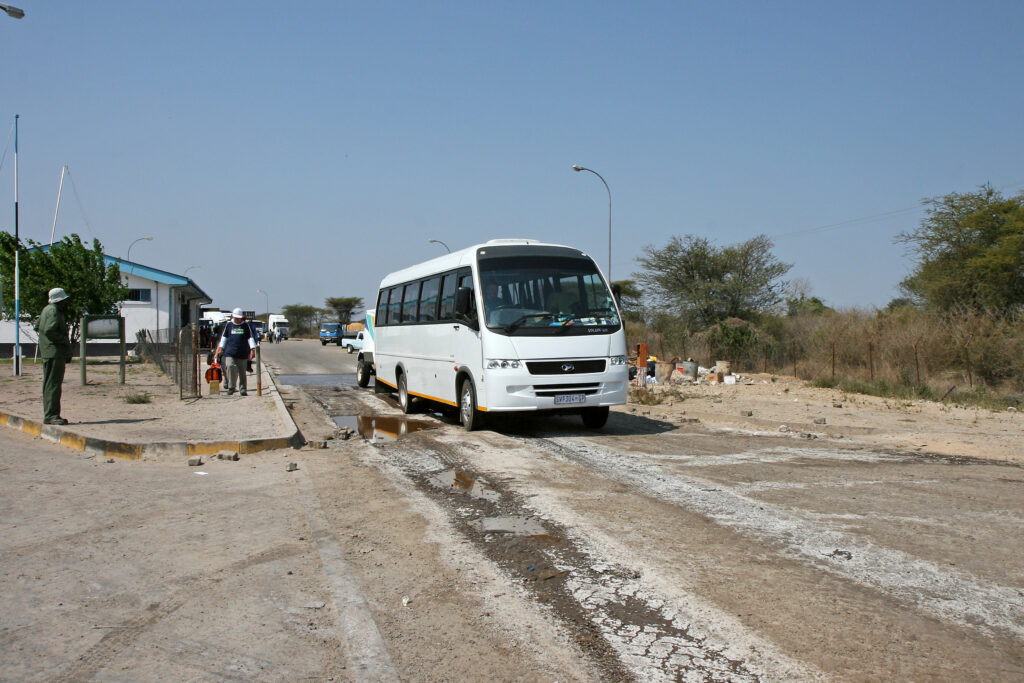
Wildlife & seasonsItinerariesA bus and travellers at the Zambia to Botswana border crossing. Photo: Frans-Banja Mulder, CC BY 3.0, via Wikimedia Commons.
Botswana is straightforward to travel in and unforgiving of assumptions. This Botswana travel planning hub covers the practical questions at orienting depth — when to go, what you need to get in, which borders work, getting around, money, connectivity and health — and flags where official sources contradict one another rather than pretending they do not.
When to go: the first Botswana travel planning decision
Botswana Tourism defines the dry season as May to August and the wet season as November to March, with April and October transitional; January and February bring the heaviest rain. Annual rainfall ranges from over 650 mm in the Chobe District to under 250 mm in the south-western Kgalagadi. The full month-by-month decision guide, including why the north and the pans peak at opposite ends of the year, is on best time to visit Botswana.
- May to August — the classic window in the north. Game concentrates on permanent water as inland pans dry, days are mild, and nights are cold: 9–12 °C in Maun and Kasane, low single figures in the Kalahari, where ground frost occurs. Dawn drives in an open vehicle are genuinely cold.
- September and October — the most concentrated game viewing of the year and the hottest, around 36 °C in Maun and Kasane before the rains break.
- November to March — the green season: afternoon thunderstorms rather than all-day rain, dispersed animals in thick grass, synchronised antelope births, migrant birds and lower rates. Tracks close.
The Kalahari runs on an inverted calendar. Botswana Tourism’s own guidance is that the Central Kalahari is best during and shortly after good summer rains, when the grasslands fill with springbok, gemsbok and wildebeest — the opposite of the Okavango and Chobe pattern. A trip covering both has to choose which it optimises for.
Entry requirements
Botswana Tourism states that citizens of most European and Commonwealth countries do not require a visa. Its own visa-required country list, however, contradicts that summary — Bulgaria, for instance, appears among the nationalities requiring visas — and the list is undated. We will not reproduce it. Confirm your own nationality’s position with the Department of Immigration and Citizenship. Passport validity, blank pages, the tourism visa process, yellow fever and documentation for children are set out on Botswana entry requirements. Where a visa is needed, applications go through the eVisa portal at evisa.gov.bw or in person at immigration offices; the portal was suspended without notice for about a month in 2025, so allow time.
The clearest official statement of duration comes from the US State Department: for US citizens, no visa is required for stays of up to 90 days, with a passport valid six months beyond arrival and departure and three blank pages. Whether 90 days applies to every visa-exempt nationality we cannot confirm. A yellow fever certificate is required if arriving from a country where yellow fever is endemic.
Children. Carry the original or a certified copy of each child’s birth certificate, and where a child travels with one parent only, a notarised consent letter from the absent parent. This is not a technicality: most arrivals transit Johannesburg, and South Africa applies its own documentation requirements to children in transit.
Borders
Botswana has land crossings with South Africa, Namibia, Zimbabwe and Zambia. Two have changed fundamentally:
- Kazungula, for Zambia — the Kazungula Bridge opened on 10 May 2021 with a one-stop border post, replacing the pontoon ferry.
- Mohembo, at the top of the Panhandle — the Okavango River bridge opened on 26 June 2022. Anything describing a Mohembo ferry is out of date.
A warning that applies to every opening time you will read. Botswana Tourism’s ports-of-entry table still lists a Kazungula ferry, years after the bridge opened. A table containing a demonstrably obsolete entry cannot be trusted for the rest, so treat every published border opening time as unverified — particularly at short-hours crossings such as Pont Drift in the Tuli Block, a drift across the Limpopo that can be impassable to vehicles when the river is high.
Getting around
Air Botswana connects Gaborone, Francistown, Maun and Kasane domestically and flies to Johannesburg, Cape Town, Harare and Lusaka; Airlink flies Johannesburg to Gaborone, Maun and Kasane. Most safari travellers route via Johannesburg direct to Maun or Kasane, bypassing Gaborone. From Maun, light aircraft carry guests to bush airstrips; Botswana Tourism gives baggage limits of 20 kg on scheduled flights and 12 kg on light aircraft, and operators require soft bags in practice.
By road, driving is on the left and the limit is 120 km/h on tar, 60 km/h in towns and villages and 40 km/h inside national parks, where you must stay on established tracks. See self-drive for the tar network, distances and vehicle paperwork.
Money
The currency is the Pula (BWP), divided into 100 thebe; pula also means rain. Visa and Mastercard are widely accepted in towns, and ATMs in larger centres accept foreign Visa cards. Remote shops, service stations, cultural sites and craft outlets typically take cash only. Banking hours are Monday to Friday 08:30–15:30 and Saturday 08:30–10:45. Amounts exceeding 10,000 BWP must be declared on entry and exit.
Connectivity
Mobile coverage comes from Mascom, Orange and BTC, with SIM cards sold in supermarkets and service stations. Coverage is town- and corridor-based, not national: major towns and portions of the main highways are covered, and the rest is not. Assume no signal in the Delta, Moremi, the Central Kalahari, the Kgalagadi, Nxai Pan and most of Chobe away from Kasane. The dialling code is +267.
Health
Botswana Tourism describes the country as one of the healthiest in sub-Saharan Africa with good primary care, and says insurance covering serious illness and, if required, medical evacuation is essential for remote-area visitors. Given that camps are reached by light aircraft and sit hours from a hospital, we put it more strongly: treat medical evacuation cover as mandatory. Malaria prophylaxis is a question for a travel clinic and varies by region and season.
One thing we will not tell you
A Tourism Development Levy for non-SADC visitors was introduced in 2017 and subsequently withdrawn when the bill was pulled for further consultation. We have found no official confirmation of its status in either direction, and Botswana Tourism’s current entry formalities page does not mention it. We therefore do not state whether it is payable on arrival — check with Botswana Tourism directly.
Plan the rest of your trip
- Destinations — the six regions and their gateways.
- Itineraries, parks and reserves, self-drive, accommodation, safaris and activities and wildlife and seasons.
Official sources
- Botswana Tourism — climate, entry formalities, money and communications
- Botswana Tourism — ports of entry (contains a demonstrably outdated entry)
- Government of Botswana — visa applications and the eVisa portal
- US State Department — Botswana country information
- SADC — Kazungula Bridge and One Stop Border Post and Botswana Daily News — Okavango River bridge opens
The decisions that follow from the month
Botswana runs on two calendars that disagree. Almost every other planning decision is downstream of which one you are travelling on.
Start with the month, then pick the region.
If you have a fixed set of dates, let them choose the country for you rather than the other way round.
All destinationsWildlife & seasons