
Best Time to Visit Botswana
Three calendars, one country — the flood, the rain and the dry, and how to plan around all three.
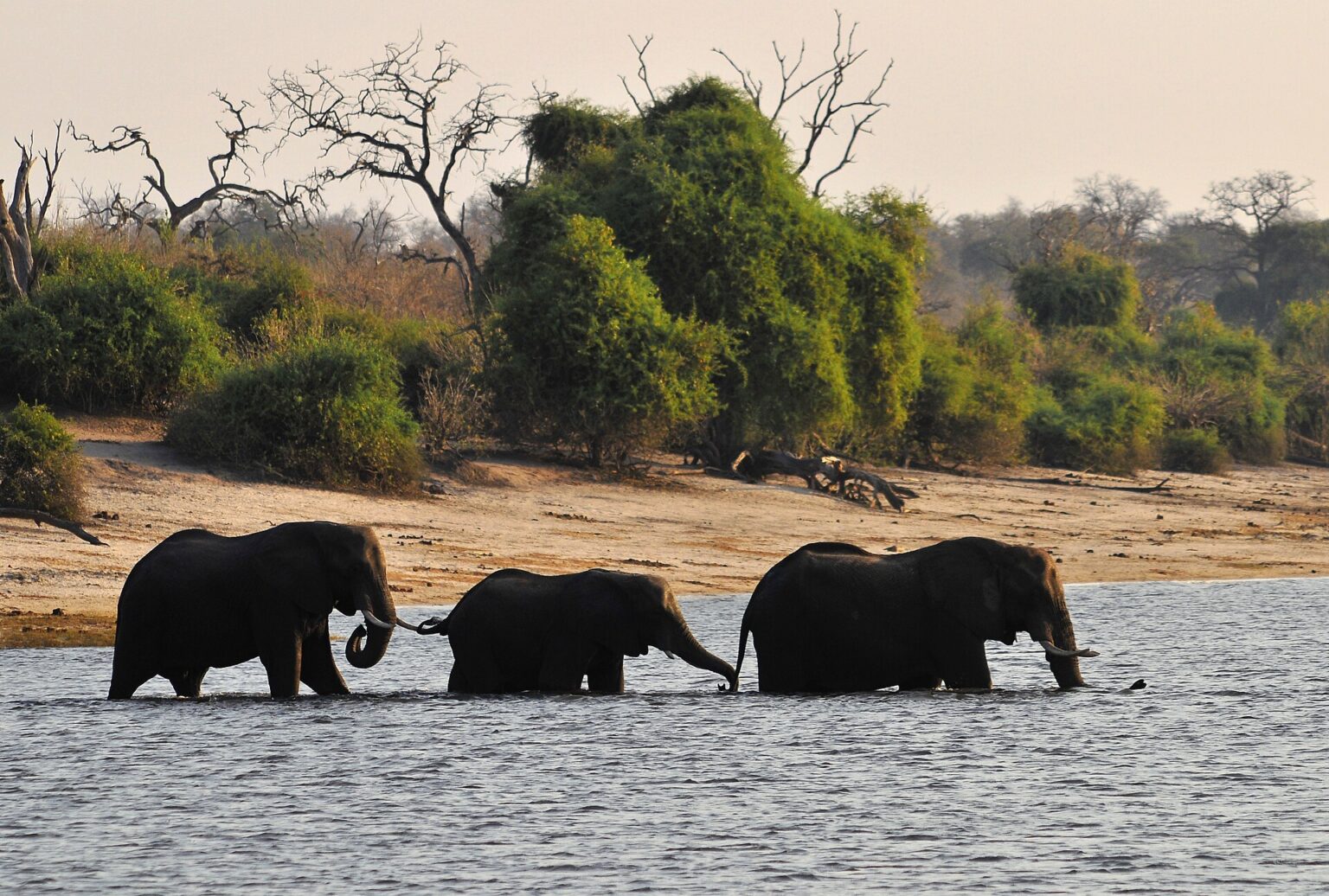
Parks and reservesDestinationsThree elephants wading across a river at dusk in Chobe National Park, Botswana, photographed in August. Photo: LBM1948, CC BY-SA 4.0, via Wikimedia Commons.
There is no single best time to visit Botswana, and anyone who gives you one month is selling something. The country runs on at least three calendars that do not agree with each other, and the right answer depends entirely on which Botswana you came for.
- Summer
- November to March, hot and wet
- Winter
- May to August, dry, cold nights
- Rain peaks
- January and February
- North at its best
- Roughly May to September
- Pans and Kalahari at their best
- December to April, if the rains come
- All figures
- Botswana Tourism Organisation
The short answer
If this is your first trip and it is built around Chobe and the Okavango Delta, go between May and September. Water is scarce away from the permanent rivers, game concentrates where it is, the mosquitoes are fewer and the roads are at their best. Botswana Tourism itself puts the optimal window at April through October.
If you are going for the Makgadikgadi pans, Nxai Pan or the Kalahari, that advice is close to backwards. Those places come alive when it rains, which means December to April, and only if the rains actually arrive.
Most itineraries try to do both. That is the real planning problem, and the rest of this page is about how to resolve it honestly.
Botswana’s seasons, as the tourism authority defines them
Botswana Tourism divides the year into two long seasons and two short transitions.
Summer runs from November to March. It brings very high temperatures: shade temperatures of 38 °C are regular and occasional peaks reach 44 °C. This is also when the rain falls. Cloud and downpours cool things considerably, but the tourism authority is careful to say only for short periods.
Winter runs from May to August. This is the dry season, when virtually no rainfall occurs. Days are sunny and cool to warm; nights drop sharply. Frost is common, small quantities of water can freeze, and in the south-west temperatures fall below zero.
April and early May, and September and October, are the transitions. Drier than summer, warmer at night than winter. They are also, not coincidentally, where a lot of the best compromises live.
Humidity follows the same split: 60 to 80 per cent on summer mornings falling to 30 to 40 per cent in the afternoon, against 40 to 70 per cent on winter mornings falling to 20 to 30 per cent.
Rain is not spread evenly across the country
This is the single most under-reported fact in most Botswana seasonal advice. Mean annual rainfall runs from over 650 mm in the extreme north-east of the Chobe District to under 250 mm in the extreme south-west of the Kgalagadi District.
That is a threefold difference across one country, and it is why a national wet season does not mean a national experience of rain. The tourism authority also notes that rainfall here is episodic and highly variable: a heavy downpour may fall in one area while there is none at all 10 or 15 km away.
Practically, this means the wet season in Chobe and the wet season in the Kgalagadi are different propositions, and that any month-by-month table — including the one further down this page — is a pattern rather than a forecast.
The north runs on the flood, not on the rain
The Okavango Delta is the reason the best time to visit Botswana cannot be read off a rainfall chart. The water that floods the Delta does not fall on the Delta. It falls in the Angolan highlands and arrives months later, which is why the Okavango is at its wettest in the middle of the dry season.
The flood reaches Maun and the Boro around mid-June and the seasonal floodplains fill through the winter. Maximum inundation in the distal Delta falls around August and September, coinciding with peak dry-season game viewing. Minimum inundation is December to March — the months when it is actually raining.
That inversion is the single most useful thing to understand about northern Botswana, and we set it out with the figures and the lag on the Okavango flood cycle.
Water across a road in the Delta in July has nothing to do with rain. It is flood, and it is arriving on schedule.
The pans and the Kalahari run on the opposite calendar
South and east of the Delta the logic reverses. The Makgadikgadi pans, Nxai Pan and the Kalahari reserves have no permanent water and no incoming flood. What they have is rain, and everything follows it.
In the Makgadikgadi, great herds of zebra and wildebeest move west towards the Boteti in the wet season, and that is when grassland game viewing peaks. At Nxai Pan, the tourism authority puts the best window at December to April, if the rains are good. In the Central Kalahari, it ties the herds explicitly to good summer rains on the reserve’s northern grasslands.
The conditional matters more than the months. A poor rainfall year delivers the heat without the spectacle. We take each of these apart on Makgadikgadi Pans National Park, Nxai Pan National Park and Central Kalahari Game Reserve.
Best time to visit Botswana, month by month
A pattern, not a forecast. Rainfall here is episodic and the flood arrives on its own schedule.
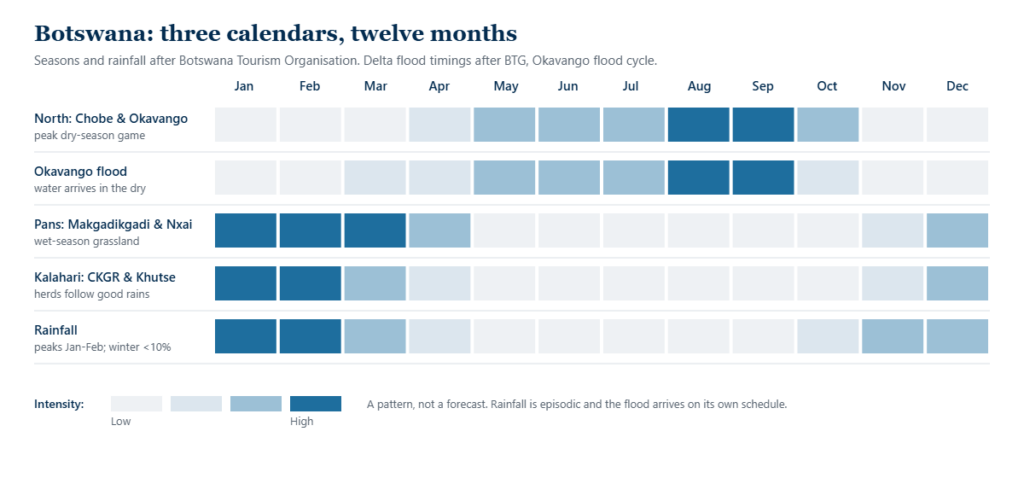
- January–February. Peak rain. Hottest and most humid. The pans and the Kalahari are at their greenest and the herds are on the grasslands. Northern roads are at their worst and some camps close. Delta inundation is at its minimum.
- March. Rain tailing off, tracks recovering, grass still high. A good compromise month for the pans, and the Okavango inlet is coming up.
- April. The first transition month: drier, still warm at night, green landscapes without peak heat. Botswana Tourism’s optimal window opens here.
- May. Winter begins. Dry, clear, cooling. The flood is moving down the Delta.
- June. The flood reaches Maun and the Boro around mid-month. Cold nights start in earnest. Northern game viewing improves as surface water dries elsewhere.
- July. Coldest month, frost inland, no rain. Excellent northern game viewing. The pans are white and empty.
- August. Maximum Delta inundation begins, alongside peak dry-season concentration. Days warming, nights still cold.
- September. Arguably the strongest single month in the north: maximum inundation, scarce water elsewhere, game concentrated, heat building.
- October. Very hot, water at its scarcest, game concentrated and demanding conditions. The end of the tourism authority’s optimal window.
- November. Summer begins. First rains may break, heat peaks before they do. The pans start to change.
- December. Rain establishing. Green season begins in the south and east. Nxai Pan’s window opens.
The best time to visit Botswana depends on what you came for
Concentrated big game. May to September, in the north. Animals are tied to permanent water and you are watching them at it.
The pans, the migration and green grassland. December to April, and accept the conditional. This is also when the pan-country activities that exist almost nowhere else are at their most atmospheric.
Birds. The summer months, when migrants are present and the pans hold water. Flamingo concentrations at Sowa and the Nata Sanctuary depend on the pans flooding, which the tourism authority ties to years of good rain and the years that follow.
Comfort. April to May and September to October. Neither the cold of July nights nor the heat of October afternoons.
Fewer people and lower prices. The green season, broadly November to March. You are trading crowd and cost against heat, mud and conditionality.
What the seasons do to the roads
Season decides the driving as much as the game viewing, and it does so differently in each region.
In the wet months, black cotton soil on the pan margins holds water and turns to a grease that stops vehicles which would cross the same ground in July without noticing it. Kalahari sand is at its softest in the heat. In the north, the obstacle in the dry season is flood water rather than rain: Delta tracks are wettest when the sky has been clear for months.
None of this changes the vehicle requirement, which is the same all year. What it changes is how much margin you need. Our 4×4 and vehicle requirements page sets out what properly equipped means before you leave the tar.
Where seasonal advice usually goes wrong
Three mistakes account for most disappointed trips.
The first is treating Botswana as one destination with one season. It is not, and the best time to visit Botswana for Chobe is close to the worst for Nxai Pan.
The second is reading the Delta as a rainfall system. It is a flood system with a months-long lag, and the two peak at opposite ends of the year.
The third is treating the wet-season spectacle as a booking rather than a condition. The pans and the Kalahari deliver when the rains come. In a poor year they do not, and no itinerary can arrange otherwise. Build the trip so that a dry year is still a good trip.
Official sources
- Botswana Tourism Organisation — Climate (season definitions and months, temperatures, frost, rainfall range and peak months, humidity, optimal travel window)
- List of protected areas of Botswana (park and reserve designations referenced on this page)
Delta flood timings on this page are summarised from our own Okavango flood cycle page, which carries the hydrological sources in full.
Reviewed August 2026. Seasons shift and rainfall varies year to year; if something here is out of date, tell us.
Plan the rest of your trip
Once the season is decided, everything else follows from it. These are the pages that turn a month into an itinerary.
Why the Delta floods in the dry season, with the lag and the figures.
Open →Makgadikgadi Pans National ParkThe wet-season park, the Boteti and the migration that reverses each year.
Open →4×4 and vehicle requirementsWhat each season does to the ground, and what the vehicle has to cope with.
Open →Pick the season, then the country.
Deciding the month first is the difference between a trip built around what Botswana does and a trip built around a brochure.
All parks and reservesAll destinations