
Nxai Pan National Park
Grassland, acacia islands and Baines’ Baobabs — the accessible half of the pans, on the wet-season calendar.
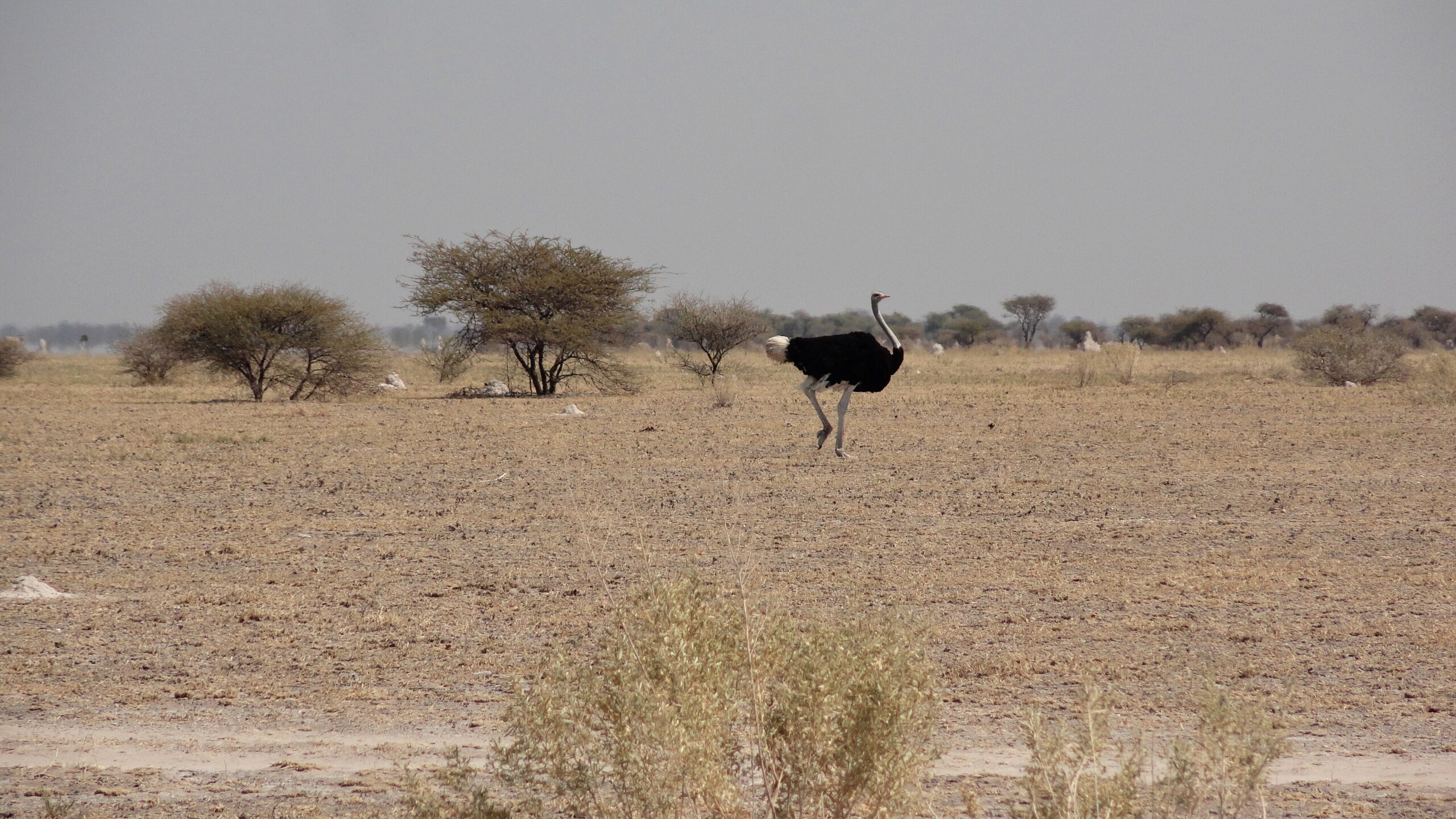
Makgadikgadi regionAll parks and reservesDry short grassland with scattered acacias and an ostrich in Nxai Pan National Park, Botswana. Photo: Fabio Achilli, CC BY 2.0, via Wikimedia Commons.
Nxai Pan National Park is the accessible half of the pans. It lies north of the Nata–Maun road in country that was once the floor of a vast lake and is now grassland scattered with acacia, and it runs on a calendar most Botswana itineraries get wrong. Where the rest of the country peaks in the dry season, this park is at its best when it has rained.
- Where
- North-central Botswana, north of the A3 between Nata and Maun
- Area
- 2,100 km² (Botswana Tourism Organisation)
- Part of
- The greater Makgadikgadi complex
- Off the main road
- 50 km (Botswana Tourism Organisation)
- Best for
- Wet-season grassland game, predators, Baines’ Baobabs
- Vehicle
- 4×4 essential inside the park
Where Nxai Pan National Park is, and how far off the road
Botswana Tourism puts the park 50 km from the Nata–Maun road. That is the single most useful number on this page, and the approach is unusually good by Botswana standards: the surfaced road runs to the entrance gate. It is what happens after the gate that decides the vehicle.
Nxai Pan National Park sits north of the A3. Makgadikgadi Pans National Park sits south of it. The two are separated by that road and by very little else, which is why they are so often discussed as a single destination and why their seasons get muddled together. They are separate parks with separate entrances, and a visit to one is not a visit to the other.
Three pans, and what they actually look like
Nxai Pan National Park holds three larger pans — Nxai Pan itself, Kgama-Kgama Pan and Kudiakam Pan. Botswana Tourism describes them as ancient salt lakes that are now grassed and scattered with islands of acacia trees.
Read that description twice before booking. The mirror-flat white crust that sells Botswana photographically is largely Sowa and Ntwetwe, south and east of here. What you get in Nxai Pan National Park is short grass, pale open ground and thorn islands — a landscape that reads as savanna rather than salt. It is excellent country for watching animals at distance, and it is not the moonscape on the postcard.
Wildlife in Nxai Pan National Park
Botswana Tourism lists zebra, wildebeest, springbok, impala, gemsbok, hartebeest and giraffe, with lion, cheetah, wild dog, brown hyena and bat-eared fox among the predators, and elephant and buffalo present at times.
That is a strong predator list for a park of this size, and the open ground is the reason. Cheetah in particular are associated with short-grass country of exactly this kind, and the sightlines that make Nxai Pan good for photography are the same sightlines that make hunting viable here.
Nxai Pan National Park maintains artificial watering points. That single fact explains a great deal about how it behaves: game does not vanish entirely when the natural pans dry, and the dry months are not empty, merely different. What changes with the seasons is the size of the herds rather than the presence of animals.
When to visit Nxai Pan National Park
Botswana Tourism is unusually direct about this: December to April is the best time to visit if the rains are good. The conditional is not decoration. In a poor rainfall year the grassland does not come, the herds do not gather in numbers, and the same months deliver heat without the spectacle.
The national picture supports the timing. The tourism authority describes Botswana’s rain as falling almost entirely in summer, peaking in January and February, with winter accounting for less than ten per cent of the annual total. Nxai Pan National Park sits inside that pattern rather than outside it.
This is why a single set of best months for Botswana is misleading. Chobe and the Okavango reward the dry season; the pans reward the wet one. If you are trying to do both in one trip, something has to give, and we set out the trade-offs on when to visit Botswana.
The best months here are also the hottest. National figures put summer shade temperatures at 38 °C and above, occasionally reaching 44 °C. Winter days are warm, winter nights are cold, and frost is common inland.
Getting there and what you need to drive
The A3 between Nata and Maun is tar, and so is the 50 km approach to the gate. Inside Nxai Pan National Park that ends abruptly. Park interiors here are sand, soft in places and heavily corrugated, and between December and April — the months you would most want to be here — sections of the internal tracks can be hard going.
The requirement is a properly equipped 4×4 with high clearance and low range, travelling with recovery gear and enough water to sit still for a day if it comes to that. The reasoning, and what properly equipped actually means, is set out on our 4×4 and vehicle requirements page.
There is no fuel inside Nxai Pan National Park. Gweta and Nata are the practical filling points on the A3, and Maun is the last full-service town to the west. Fill before the turn-off, not after it.
Baines’ Baobabs
A group of seven baobabs stands roughly 30 km from the entrance to Nxai Pan National Park. They carry the name of Thomas Baines, the explorer and artist who painted them during the journey he made between 1861 and 1863 with the trader and hunter James Chapman, travelling from what is now Namibia to the Victoria Falls. The distance, the number of trees and the dating all come from Botswana Tourism.
Baines left a line about reaching them: the party “walked forward to the big tree, the Mowana at Mamu ka Hoorie”. A painted record of a specific group of living trees, made more than a century and a half ago, is an unusual thing to be able to stand in front of, and it is most of why people make the detour.
Treat the baobabs as a separate excursion rather than a stop. Thirty kilometres in this country is not a fifteen-minute diversion, and the ground around the trees is soft. Park where the track ends and walk the last stretch.
Nata Sanctuary and the wider complex
Botswana Tourism treats Nxai Pan and the Nata Sanctuary as parts of one story, and it is worth knowing why. The sanctuary covers 250 km² at the northern end of Sowa Pan, and it was Botswana’s first community-based conservation project, opened to the public in 1993.
When water fills the pans, the tourism authority describes thousands of flamingos, pelicans, ducks and geese congregating there. It also notes reasonably priced camping facilities, which makes the sanctuary one of the more affordable ways into the pan country.
The sanctuary is not part of Nxai Pan National Park and it is not next door to it — it sits beside the village of Nata, which is also the last dependable fuel before this park — it lies east, near Nata, at the far end of the complex. Treat it as a second stop on the same road rather than a day trip, and note that the water it depends on is the same conditional rainfall that governs everything else here.
Reading the rains before you book
Every recommendation on this page is hedged the same way, because the source is: December to April is best if the rains are good. That conditional is the difference between the trip people describe afterwards and the trip people regret.
There is no way to guarantee it and we are not going to pretend otherwise. What you can do is book flexibly, keep the pans leg late in the itinerary so you have information before you commit, and ask an operator what the ground has actually done this year rather than what it usually does. The people running camps out here have every reason to be straight with you: a guest who arrives expecting herds in a dry year is nobody’s good outcome.
If the rains have failed, the honest answer is to move the pans down the itinerary and spend the nights in the north instead. That is a better trip than a disappointed one, and it is why we treat season as the first planning decision rather than the last.
Nxai Pan National Park or the Makgadikgadi park?
They are neighbours and they are not substitutes. Botswana Tourism gives Nxai Pan 2,100 km² and the Makgadikgadi park 3,900 km², but size is the least interesting difference between them.
Nxai is grassland with acacia islands and artificial waterholes, reached by a single 50 km approach, and it holds animals through the year. The Makgadikgadi park is defined by the Boteti on its western edge and by a seasonal migration of zebra and wildebeest that moves west in the wet season and concentrates on the river in the dry one. One park is about a place; the other is about a movement.
If you have one night, take Nxai — the access is simpler and the game is less conditional. If you have three or more and the Boteti is flowing, the Makgadikgadi side rewards the extra effort. We set both against the wider region on the Makgadikgadi region page, and cover the neighbouring park in full on Makgadikgadi Pans National Park.
Where to stay
Accommodation divides between a government campsite inside the park, community campsites in the surrounding area, and private camps on concession land outside the boundary. We publish no rates, no availability and no ratings of our own; what we can tell you is what a property is and where it sits. Our catalogue is small and growing region by region — start at accommodation in Botswana.
Properties we have checked nearby
The camp inside Nxai Pan, the Boteti lodges, and the A3 route stops at Gweta and Nata.
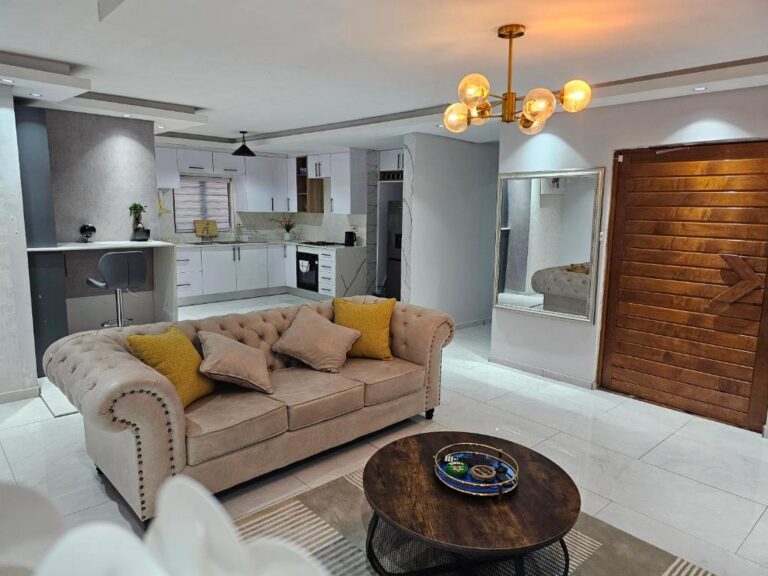
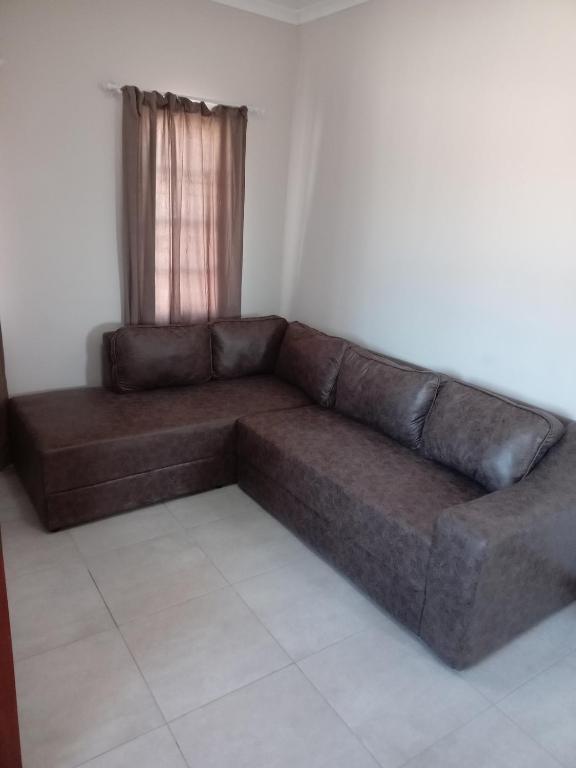
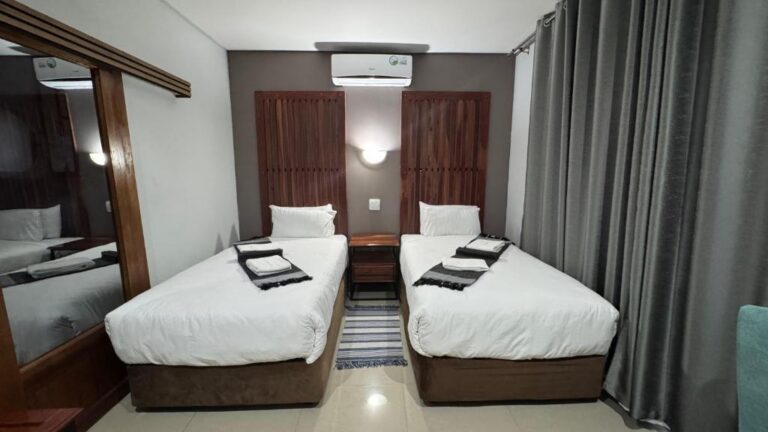
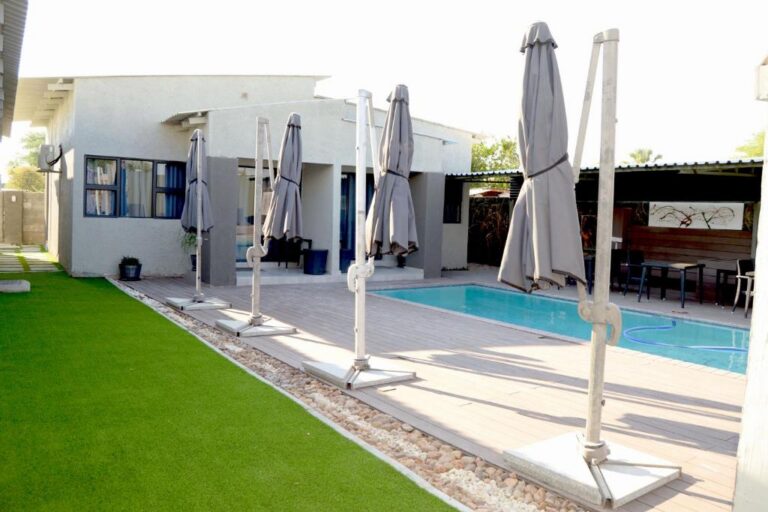
View all 20 Makgadikgadi and Nata propertiesAll Makgadikgadi and Nata accommodation
Every card opens our own property page first. We publish no rates, no availability and no ratings of our own.
Guided trips through the pans country
Multi-day safaris we list that take in Nxai Pan and the wider Makgadikgadi.

Every card opens our own tour page first. Booking happens on the operator’s site, where the live price and availability are.
Outside the park, the nearest beds are at Nata and Gweta on the A3. Staying inside means camping: camping in Botswana covers the site operators and the booking order. The road access is off the A3 — see Maun to Nata.
Sources and references
- Botswana Tourism Organisation — Nxai Pan National Park (area, distance from the Nata–Maun road, the three pans, wildlife, best time, artificial watering points)
- Botswana Tourism Organisation — Makgadikgadi Pans (Baines’ Baobabs: seven trees, distance from the Nxai Pan entrance, Baines and Chapman 1861–1863)
- Botswana Tourism Organisation — Climate (seasons, temperatures, rainfall distribution)
- List of protected areas of Botswana (designation as a national park)
Reviewed August 2026. Park areas, names and access arrangements change; if something here is out of date, tell us.
Plan the rest of your trip
Nxai Pan National Park is one leg of a pans trip, not the whole of it. These are the pages that decide the rest.
300 km of tar between two national parks, and where the fuel actually is.
Open →Makgadikgadi Pans National ParkThe park across the road, on the Boteti and a migration calendar of its own.
Open →Makgadikgadi & the Salt PansThe wider region, the two great pans and the towns on the A3 you actually pass through.
Open →4×4 and vehicle requirementsSand, black cotton and what “properly equipped” means before you leave the tar.
Open →Botswana 14 day itineraryTwo nights here, on the fortnight loop through the pans.
Open →Come for the rain, not the crust.
Nxai Pan National Park is at its best in the months most Botswana itineraries spend somewhere else. Decide the season before you decide the camp.
When to visit BotswanaAll parks and reserves