
Botswana Wildlife & Seasons
What moves when, why the north floods in the dry season, and where the zebra actually go — with the uncertainties left in.
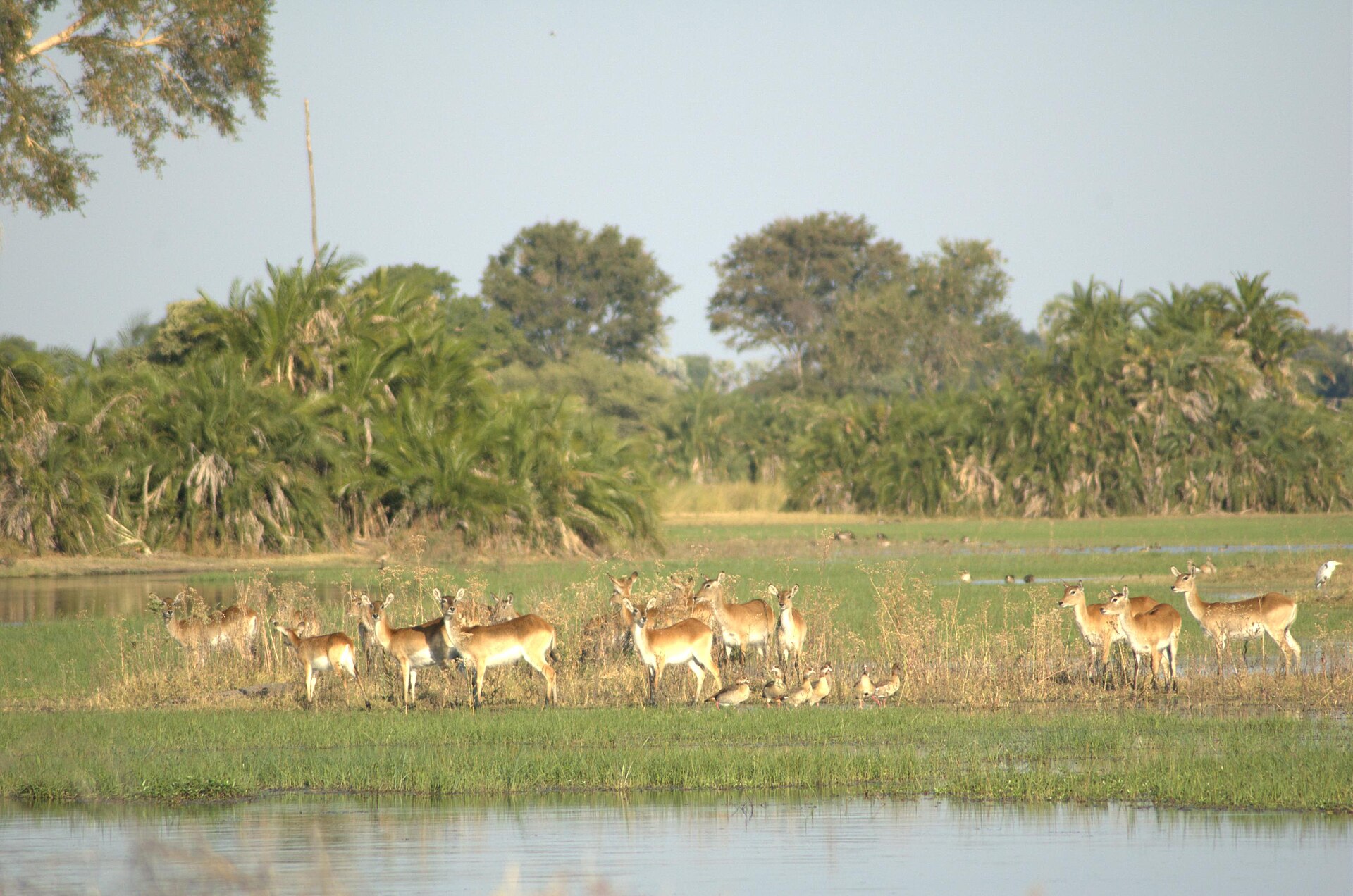
The Okavango flood cycleTravel planningA group of red lechwe on a floodplain at dawn in the Okavango Delta, Botswana. Photo: PanBK at English Wikipedia, CC BY-SA 3.0, via Wikimedia Commons.
Botswana wildlife runs on two clocks that work against each other: the Okavango flood, which arrives in the middle of the dry season, and the ordinary rainfall year, which soaks the Kalahari when the north is at its driest. Between them they explain almost every timing decision in a Botswana trip.
The two cycles behind Botswana wildlife
The Okavango flood
Rain falls on the Angolan highlands in the southern summer and takes months to reach Botswana. Peak discharge at Mohembo comes around March to April; maximum inundation at the far southern and eastern ends of the Delta around August to September. UNESCO’s inscription states it plainly: the flooding occurs during the dry season, and the Delta’s species have synchronised their cycles to it. Flooded area varies hugely between years, and local rainfall is not the driver. See our Okavango flood cycle guide.
Dry season and green season
Elsewhere the ordinary pattern applies. In the dry months, roughly May to October, inland pans fail and animals are forced onto permanent water, producing the concentrations the country is famous for and peaking in September and October. In the green season, November to March, animals disperse and grass is high; the compensations are synchronised antelope births, migrant birds, and the Kalahari turned from bare pan to grassland. Neither is better, and the Kalahari peaks when the north does not.
Two zebra migrations, and they are not the same one
- Okavango to the Makgadikgadi. A round trip of about 588 km, out around November and back April to May. A veterinary cordon fence severed the route from 1968 to 2004; once removed, the migration re-established itself. Roughly 55% of collared zebra at the Delta periphery migrated and the rest stayed, and the literature is explicit that nobody knows why. Note that what visitors see on the Boteti in the dry months is the aggregation on the last permanent water, not the migration.
- Chobe to Nxai Pan. From the Chobe floodplains south to Nxai Pan, a round-trip straight-line distance of about 500 km, departing in December and taking a mean of 85 days to return against 15 southbound. Billed on publication as the longest in Africa, the claim is disputed in the peer-reviewed literature: it holds by straight-line distance, but rival work argues the white-eared kob covers more ground.
Headline species, with honest expectations
- Elephant. The 2022 KAZA Elephant Survey estimated 227,900 across the Kavango–Zambezi landscape, of which Botswana held 131,909, about 58%. The trend is contested: Elephants Without Borders found northern Botswana essentially unchanged over 2010–2022, growing about 1% a year, against government figures nearer 6%. Both attributed, neither resolved.
- African wild dog. The one claim where marketing and science agree. IUCN lists the species Endangered, roughly 6,600 adults and yearlings globally, and states the largest populations remain in southern Africa, especially northern Botswana — making the Okavango, Khwai, Linyanti and Selinda among the best places on Earth for it. Denning, in the dry months, ties a pack to one place.
- Lion and leopard. Lion across the Okavango, Moremi, Savuti, Linyanti and the Central Kalahari, where black-maned Kalahari lions are the draw. For leopard, Moremi and neighbouring Khwai are the conventional recommendation — the reason being access rather than density, since Khwai permits off-road driving and night drives and Moremi does not. We publish no population figures for either.
- Cheetah and brown hyena. Both are Kalahari and Makgadikgadi animals. Cheetah are best in the green season and just after; IUCN lists them Vulnerable, and around three-quarters of estimated resident range in the region lies outside protected areas. Brown hyena, the rarest hyena and a southern African endemic, are nocturnal and largely a matter of luck.
- Red lechwe and sitatunga. Lechwe are the signature antelope of the Okavango floodplains, shifting with the flood. Sitatunga are the speciality — semi-aquatic, in dense papyrus, realistically found in the Panhandle by boat rather than vehicle, and genuinely hard to see.
- Rhino. The reintroduced Delta population suffered severe poaching from 2018, and in 2021 government announced it would move remaining wild rhino to sanctuaries. Whether free-roaming rhino remain in the Delta is unresolved, and figures are security-sensitive, so we publish no counts and no locations. The honest recommendation is Khama Rhino Sanctuary near Serowe, in eastern Botswana. Treat “Big Five Botswana” marketing with scepticism.
Birding and the carmine window
The birding calendar inverts the mammal calendar: peak birding is the green season, roughly November to March, when migrants arrive and residents are in breeding plumage. The Okavango records 482 bird species, the wider Ramsar system over 650. The southern carmine bee-eater is the flagship spectacle: birds arrive in the northernmost zones in August and September, breeding runs to January with laying completed by November, and most leave in March — so colonies are realistically viewable roughly September to November, overlapping peak dry-season game viewing. They are easily disturbed and readily abandoned.
Flamingos at Sua Pan are conditional, not guaranteed. The Makgadikgadi is southern Africa’s most important breeding site for greater and lesser flamingo, and an aerial survey counted over half a million birds in the northern basin in June 2019 — but those birds were feeding, not breeding, and presence depends on the pan holding water. In a dry year there may be almost nothing.
Conservation, presented even-handedly
Botswana banned hunting on public land in 2014 and lifted the ban in 2019, citing human–wildlife conflict. Hunting does not occur in national parks or game reserves, but under quota in controlled hunting areas and Wildlife Management Areas. Independent scientists argue current elephant quotas erode the oldest bulls, and some in the hunting sector agree. Against that, the ban removed roughly two-thirds of all community trust revenue nationally, and most northern concessions are not viable as photographic destinations, so photographic tourism cannot simply substitute.
The human cost falls on rural households in Ngamiland and Chobe — crop destruction, property damage, injuries and deaths — with over BWP 120 million spent on compensation and recurring grievances about delayed payment. Population trend, offtake sustainability, community benefit and welfare are separable questions, and we keep them separate rather than collapsing them into a verdict.
Guided game drives you can book
Morning and afternoon drives into the parks, with fixed departure times and a guide who knows the ground.

Every card opens our own tour page first. Booking happens on the operator’s site, where the live price and availability are.
Plan the rest of your trip
- The Okavango flood cycle — the mechanism in detail.
- Safaris and activities — where each species is realistically seen.
- Parks and reserves, destinations, itineraries, self-drive and travel planning.
Sources and references
- UNESCO — Okavango Delta, Ramsar — Okavango Delta System and Wolski & Murray-Hudson on flood hydrology
- KAZA Elephant Survey 2022 and Elephants Without Borders
- IUCN — African wild dog and cheetah
- Southern African Bird Atlas — southern carmine bee-eater
- International Rhino Foundation and EIA — rhino poaching in Botswana
- Botswana Tourism — climate and wildlife viewing
Plan the rest of your trip
Seasonality in Botswana is regional. A month that is excellent in one place is the wrong month 400 km away.
Where the water comes from, and the lag that reverses the calendar.
Open →Makgadikgadi & the Salt PansThe wet-season country, and the zebra movement.
Open →Chobe & KasaneThe dry-season river concentrations, and when they peak.
Open →Two calendars, one country.
The single most useful thing to understand before you pick a month.
Plan your tripAll destinations