
4×4 and Vehicle Requirements for Botswana
Where an ordinary car is genuinely adequate, what “properly equipped” means in practice, and which rules we could not verify.
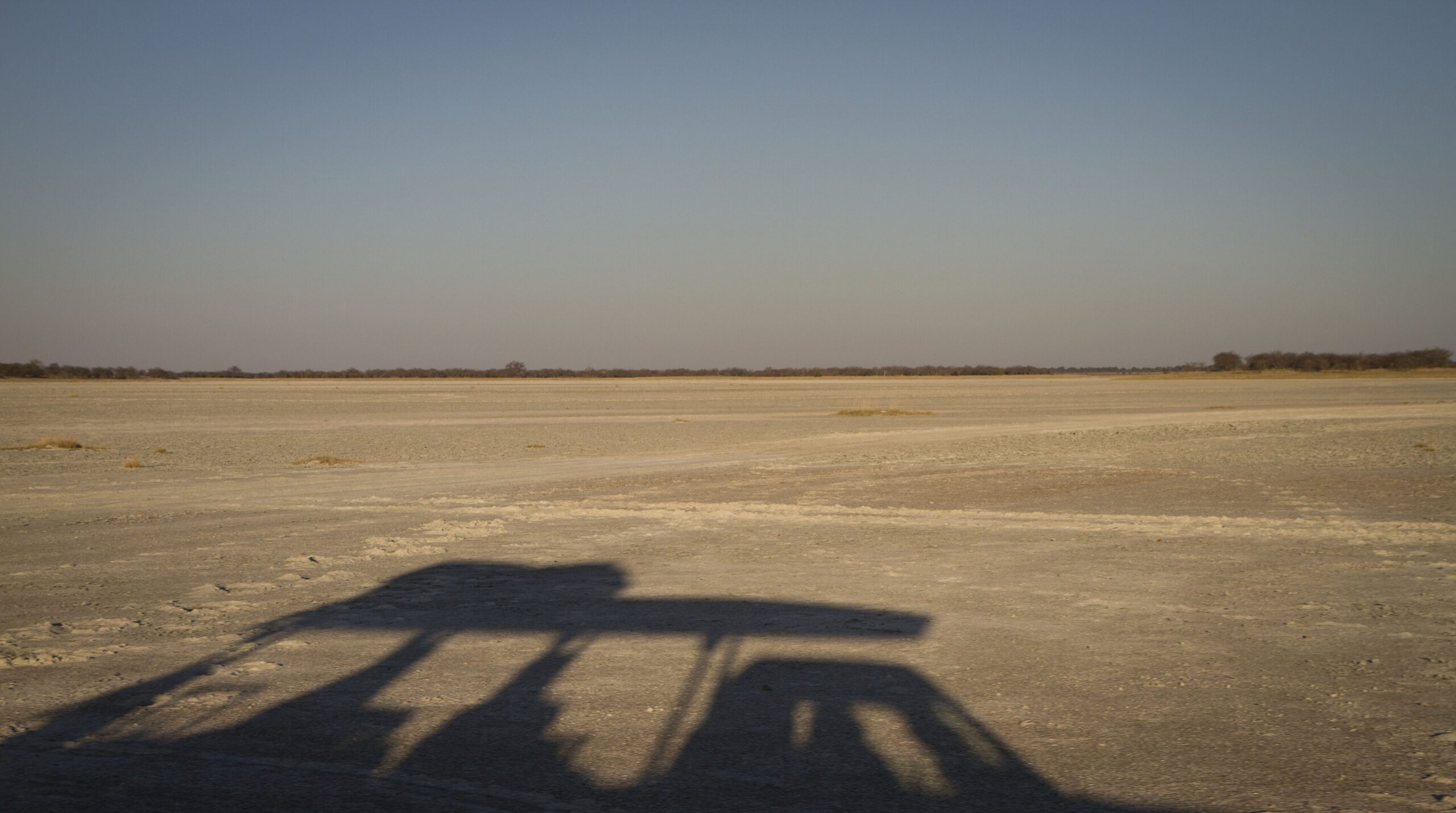
Self-drive BotswanaItinerariesThe shadow of a safari vehicle on the open pan at Nxai Pan National Park — the sort of ground a 4×4 in Botswana is bought for. Photo: Ana Isabel Alia, CC BY-SA 4.0, via Wikimedia Commons.
Botswana is one of the few countries where the vehicle decides the itinerary. A 4×4 in Botswana is not a comfort upgrade — on most of the routes people come here to drive, it is the difference between reaching a booked campsite and spending the night digging. This guide covers where an ordinary car is adequate, what “properly equipped” means, what Botswana Tourism Organisation’s own advice says, and which rules we could not verify.
At a glance
- Tar is a thin network. The A1, A2, A3, A33 and A35 are surfaced and a saloon car handles them. Everything off them is sand, and every park interior is 4×4 country.
- High clearance plus low range is the baseline, with all-terrain tyres, a compressor, recovery gear and long-range fuel capacity.
- BTO’s published minimum: at least 100 litres of fuel in long-range tanks and/or metal jerry cans; at least 20 litres of water per person, 50–100 for desert destinations; spare parts and at least one spare wheel.
- Speed limits: 120 km/h on tar, 60 in towns, 40 inside parks, where you must stay on established tracks. Driving is on the left.
- Fuel and signal are both patchy. Fuel is reliable only in the main towns and absent inside every park; coverage ends with the tar, so remote travel needs satellite communication.
Why a 4×4 in Botswana is not optional — and where a normal car is fine
Botswana has roughly 31,700 km of road, about 20,000 km of it paved. That network is genuinely good, and worth being precise about, because much self-drive writing implies the whole country is impassable without a winch.
You do not need a 4×4 for the tar. A saloon car drives the whole trunk network: the A1 eastern corridor from the Zimbabwe border to Ramatlabama; the A3 from Francistown through Nata to Maun and on towards Ghanzi; the A2 Trans-Kalahari Highway from Mamuno to Pioneer Gate; the A33 from Ngoma via Kazungula to Nata; and the A35 up the panhandle to Mohembo.
The sharpest illustration of the boundary is Nxai Pan National Park: tar runs to the gate off the A3, and 4×4 is essential from the gate inwards. The park boundary, not the map, is where the requirement changes. Beyond it lies deep Kalahari sand, calcrete, seasonal mud and unmaintained track — Moremi, Chobe including Savuti and Mababe, the Central Kalahari, Khutse, the Makgadikgadi and the Botswana side of the Kgalagadi.
BTO describes remote areas as “accessible only by four-wheel drive”, over rough terrain and heavy sand. For accuracy: BTO does not state the requirement on every park page — for the Central Kalahari and Khutse it rests on operator sources, though operators are unanimous.
What “properly equipped” actually means
“4×4” on a rental agreement is not the specification that matters. The working requirements are genuine high clearance and low range — all-wheel-drive crossovers are not the same class; all-terrain tyres in good condition, since sidewall damage from thorn and calcrete is the commonest failure; a compressor and tyre-repair kit; recovery gear — rated strap and shackles, a sand-capable jack with base plate, a shovel, ideally traction boards; and long-range fuel and water capacity.
On spares, BTO’s published minimum is “at least one spare wheel”, carried with spare vehicle parts; a full-size spare on a matching rim is the useful form of it. Two is common practice in the remoter reserves, but one is the stated minimum. BTO’s guidance here is unusually specific for an official source, and worth following literally:
- Carry at least 100 litres of petrol in long-range tanks and/or in metal jerry cans.
- Take at least 20 litres of water per person, preferably more; for desert destinations, between 50 and 100 litres.
- Take spare vehicle parts for breakdowns, including at least one spare wheel.
Sand driving
Deflate. Lower pressures lengthen the contact patch and let the tyre float rather than dig. It is the most effective single thing you can do, and why a compressor is not optional: running deflated at speed on gravel or tar risks rolling a tyre off the rim.
Momentum, not power. Steady progress in a suitable gear beats aggressive throttle; wheelspin digs. If the vehicle bogs, ease off and reverse out along your own tracks. Follow the existing tracks — established ruts are compacted and the sand between them is not, and inside parks this is a rule as well as a technique. Deep sand also drives fuel consumption far above anything you will have seen on tar. See our self-drive section.
Water crossings, black cotton and the Moremi bridges
Two mechanisms put water across Botswana’s tracks and travel writing routinely conflates them. Rain, roughly December to March, waterlogs black-cotton soils and closes routes in Moremi, Savuti and around the pans. The Okavango flood, roughly May to August, puts water across Delta tracks months after the last rain fell. Knowing which you face is most of seasonal route planning — see our wildlife section.
Black cotton is the underestimated hazard: dry it is a good surface, wet it becomes a greasy clay that packs the tread solid, and four-wheel drive does not help once it does. Avoidance and timing, not technique. Water crossings mean knowing your wading depth and accepting that a crossing fine outbound may not be on the return — and hippo and crocodile are a genuine reason not to wade some Delta crossings at all.
The Moremi bridges carry a five-tonne vehicle limit. The Third Bridge–Xakanaxa route crosses First, Second and Third Bridges, and Third Bridge is frequently damaged in the rains. This matters mainly to heavier overland trucks and anyone towing. On sourcing: the five-tonne figure comes from a specialist self-drive source, not a DWNP publication, so confirm it with the reserve or the Department of Wildlife and National Parks if your vehicle is near that weight.
Speed limits and the rules inside parks
- Driving is on the left.
- 120 km/h national limit on tarred roads; 60 km/h in towns and villages.
- 40 km/h inside national parks, and you must always stay on the established tracks.
- Mobile phone use while driving attracts a penalty — BTO gives it as P300 and recommends hands-free.
Two more things behave like rules. Livestock and wildlife on unfenced roads make night driving genuinely dangerous — plan arrivals in daylight. And off-road driving inside national reserves is prohibited outright; one operator source reports a heavy fine in Moremi, though we could not verify the amount. Concessions differ — see parks and reserves.
Fuel planning
BTO warns that in remote areas water, petrol or food may not be available:
- Reliable: Gaborone, Francistown, Maun, Kasane, Ghanzi, Palapye, Serowe, Nata, Lobatse, Kanye, Molepolole, Letlhakane and Tsabong.
- Intermittent or absent: Rakops, Gumare and Werda — each sitting exactly where you would most want a guaranteed fill: before the eastern Central Kalahari, on the panhandle run, and on the thinly served road towards Tsabong.
- None at all: inside every national park and game reserve.
Assume the intermittent stops will be dry, treat 100 litres carried as the floor for remote legs, and carry pula — remote service stations take cash only.
The Kgalagadi convoy question — unresolved
This is safety-relevant and our sources contradict each other, so we set out both positions rather than resolve them.
- BTO states that self-drive campers in the Kgalagadi Transfrontier Park must travel in convoys of a minimum of two properly equipped 4×4 vehicles. SANParks corroborates it, saying all routes within Botswana are to be travelled by no fewer than two vehicles, and that 4×4 is mandatory on the Botswana side.
- A specialist self-drive source contradicts this, holding that single vehicles are acceptable for ordinary self-drive camping in Mabuasehube, and that the two-vehicle minimum applies only to the pre-booked Wilderness Trails.
We cannot tell you which is currently enforced, and guessing wrong runs both ways: turned back at a gate after a very long approach, or alone and unrecoverable in one of the emptiest landscapes in southern Africa. Confirm the current rule with the Department of Wildlife and National Parks, and treat a second vehicle as the prudent default whatever you are told.
Communications: treat Botswana as offline
BTO’s wording is the important part: “All major towns in Botswana are network-covered, as well as portions of the national highway.” Coverage is town- and corridor-based, not national. Assume no signal in the Delta, Moremi, the Central Kalahari, the Kgalagadi, Nxai Pan, most of Chobe away from Kasane, and long stretches of the A3, A30 and A35. Camps use satellite communications and so should you — alongside medical insurance including evacuation cover, which out here is mandatory rather than optional.
Hiring versus bringing your own vehicle
Hiring in Maun, Kasane or Gaborone gets a vehicle already specified for the terrain — usually rooftop tents, recovery gear and long-range tanks — and removes the cross-border paperwork. Rates vary by operator and season and we do not publish figures we cannot verify. Check fuel and water capacity, spares and rims, whether a compressor and repair kit are included, and whether the terms permit the parks you plan to enter.
Bringing your own vehicle means paperwork. Driving licences must be carried at all times; BTO states that licences from neighbouring countries and international licences are accepted, with certified translations where a licence is not in English. BTO says non-residents from outside the Southern African Common Customs Area typically need carnets or bills of entry, and BURS requires a Temporary Import Permit issued at entry or an ATA Carnet, plus clearance documents and Form SAD 500.
The only fee we can confirm as officially current is the National Road Safety Fund levy of P40, expiring 31 December annually, payable on all foreign-registered vehicles per BURS; a Road Transport Permit levy is charged per entry on laden load, but BURS publishes no schedule. For a vehicle you do not own outright, a letter of authority from the owner, bank or rental company is standard.
Two cautions. The border-fee checklist circulating in the self-drive community — road permit, road fund disc, trailer fee, third-party insurance and a neat total — traces back to a 2015 news article; those figures are eleven years old and we will not republish them. And “blue triangles”: we could not verify any official Botswana requirement for them from any government source. The regional reflective-marking rules that do exist concern red/white or yellow/red tape and triangles on trailers, caravans and heavy vehicles. Confirm with the Botswana Road Traffic regulations or the Department of Road Transport and Safety, and confirm charges with BURS. See travel planning.
Road conditions and closures
Route status here is perishable, and this is the part of any self-drive guide most likely to be out of date by the time you read it. After the 2025/26 rains, Moremi Game Reserve reopened on 13 April 2026 with restricted access. Third Bridge remained closed until further notice; Khwai–Xakanaxa was deemed inaccessible; Khwai–South Gate was called difficult and potentially hazardous, for experienced off-road travellers only; South Gate–Xakanaxa was rated fair. An earlier reopening planned for 27 March had been postponed for continuing rain.
The standing lessons rather than the specifics: Moremi can close entirely for a week or two in heavy rain between December and March; Third Bridge is damaged most years; the Maun–Moremi–Chobe routing fails first; and the A2 has been flagged for potholes. Verify current gate and route status with DWNP before committing to a route through Moremi or Chobe, and do not rely on any published route description — including ours — being current.
Where the long legs break
The Trans-Kalahari and the A3 are the two stretches that decide how hard a self-drive feels. These are the practical stops.
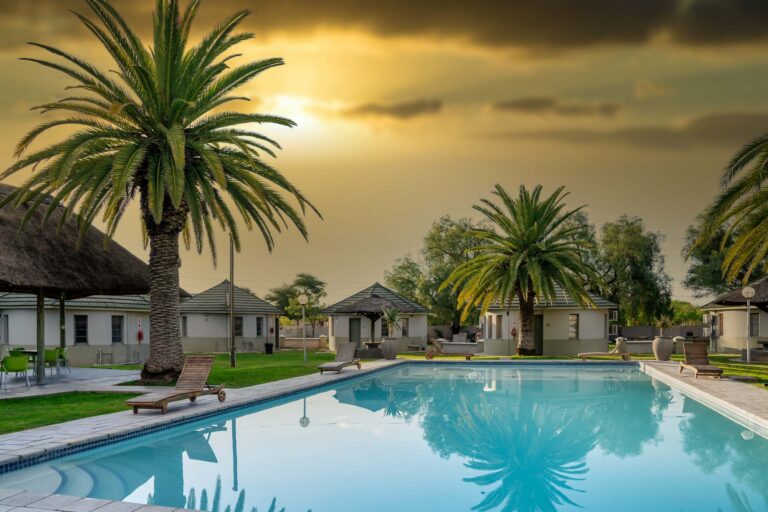
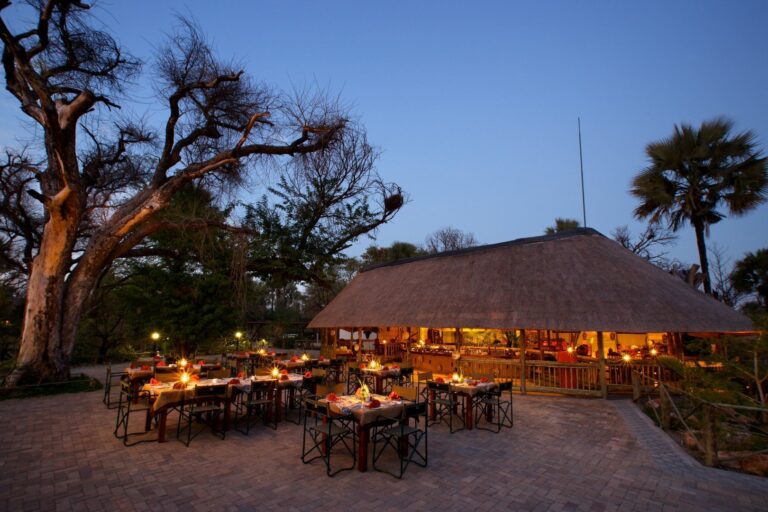
Plan the rest of your trip
- Self-drive — routes, campsite booking and convoy practice.
- Parks and reserves and Moremi — rules, gates and bridges.
- Okavango Delta, Kalahari, Chobe and Kasane.
- Travel planning, itineraries, accommodation.
Sources and references
- Botswana Tourism Organisation — Self-drive camping
- BTO — Entry formalities
- BTO — Communications
- BTO — Kgalagadi Transfrontier Park
- SANParks — Kgalagadi route rules
- Botswana Unified Revenue Service — Clearance of motor vehicles
- Government of Botswana — DWNP park and campsite bookings
- Botswana Daily News — Moremi road closures
Continue planning
Whether driving yourself is the right shape of trip, and what it demands of you.
Open →ItinerariesRoute shapes that work in practice, and the distances between them.
Open →Travel planningVisas, money, health, connectivity and the seasonal question.
Open →The vehicle rules the itinerary in.
Read this page before you commit to a route, not after you have booked the camps.
Self-drive BotswanaItineraries