
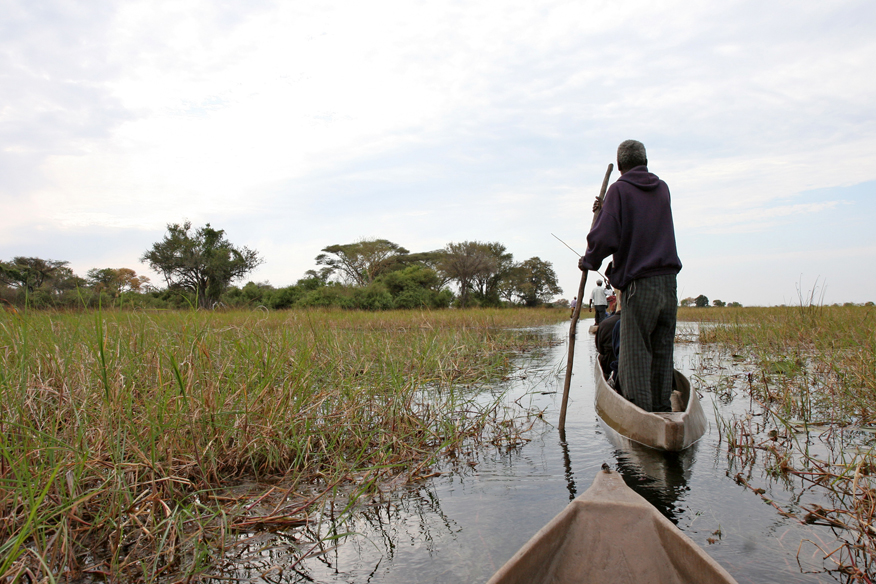
The Okavango Panhandle is the long, comparatively confined river corridor where the Cubango–Okavango enters Botswana before spreading into the Delta. Because the water is still channelled here, a rising upstream hydrograph can be easier to read than in the maze farther south.
That does not make the Panhandle a crystal ball. Local rain, channel distribution, evaporation and travel time all separate a gauge reading from the water beside a named camp. Use the Panhandle as an early signal and then move down to the local operational question.
Last checked
21 September 2026. Conditions, rules and operator arrangements can change. Confirm the details that affect your trip with the responsible authority or operator before travelling.
In this guide
Read the Okavango Panhandle as an upstream station
Record the station, variable, unit, observation date and source. Water level and discharge are related but not interchangeable. Compare the current line with the same station in several previous years rather than with a photograph or lodge depth from another part of the Delta.
Turn that into a practical check: Is this figure a level or discharge measurement, and is it observed, provisional or modelled? Ask for a dated answer, note who supplied it, and keep it with the booking or route plan. That small record is more useful than an undated recommendation copied from another trip.
Follow the direction, not one dramatic number
A sustained rise, the date the rise began and its rate are more informative than a single value. Historical curves show whether the incoming pulse is early, late or broadly typical, while still leaving uncertainty about where and when water will spread next.
Turn that into a practical check: How does the current curve compare with several historical years at the same date? Ask for a dated answer, note who supplied it, and keep it with the booking or route plan. That small record is more useful than an undated recommendation copied from another trip.
Choose a Delta base by activity
Boating, mokoro travel, fishing and game drives depend on local water and access. Compare regions before treating every Okavango stay as interchangeable.
Separate upstream flood from local rainfall
Summer rain can wet roads and fill local pans before the Angolan flood pulse arrives. Later, the main flood may expand during Botswana’s dry season. A traveller therefore needs two checks: recent local rain for immediate access and upstream inflow for the wider seasonal picture.
Turn that into a practical check: What has fallen locally in the last week, and what is arriving from upstream over the coming weeks? Ask for a dated answer, note who supplied it, and keep it with the booking or route plan. That small record is more useful than an undated recommendation copied from another trip.
Translate hydrology into an activity question
A river graph does not say whether a particular mokoro route, fishing area or boat transfer is operating. Ask the lodge which activities are running, where boats launch, whether a road transfer has changed, and how the answer differs from the same date last year.
Turn that into a practical check: What can guests actually do at this base this week, and which logistics changed because of water? Ask for a dated answer, note who supplied it, and keep it with the booking or route plan. That small record is more useful than an undated recommendation copied from another trip.
Use ranges instead of promised dates
The Delta is extremely flat and branching. A precise arrival date for a distant lagoon implies more certainty than one station can provide. Plan with a broad expectation, choose a property for the activities it can usually offer, and repeat the local check close to travel.
Turn that into a practical check: What is the plausible range of conditions, and which part of the trip remains useful at either end of that range? Ask for a dated answer, note who supplied it, and keep it with the booking or route plan. That small record is more useful than an undated recommendation copied from another trip.
Practical checklist
- Record the station, unit, date and source.
- Compare several historical curves.
- Check local rain separately from upstream inflow.
- Ask the operator what activities are running now.
- Update the local check close to travel.
Sources and verification
The main references used for this article were OKACOM river-basin information, UNESCO Okavango Delta Management Plan 2021–2028. The sources answer different parts of the question. Where an authority is silent, a rule is volatile or research does not support a neat conclusion, the article preserves that uncertainty.
Our Okavango Delta guide explains the wider landscape.
The Okavango Panhandle is valuable precisely because it answers a narrow question about incoming water. Preserve that scale, then obtain a second, local answer for the experience you intend to book.