
Ghanzi
Cattle country, the Trans-Kalahari Highway and the western way into the Kalahari.
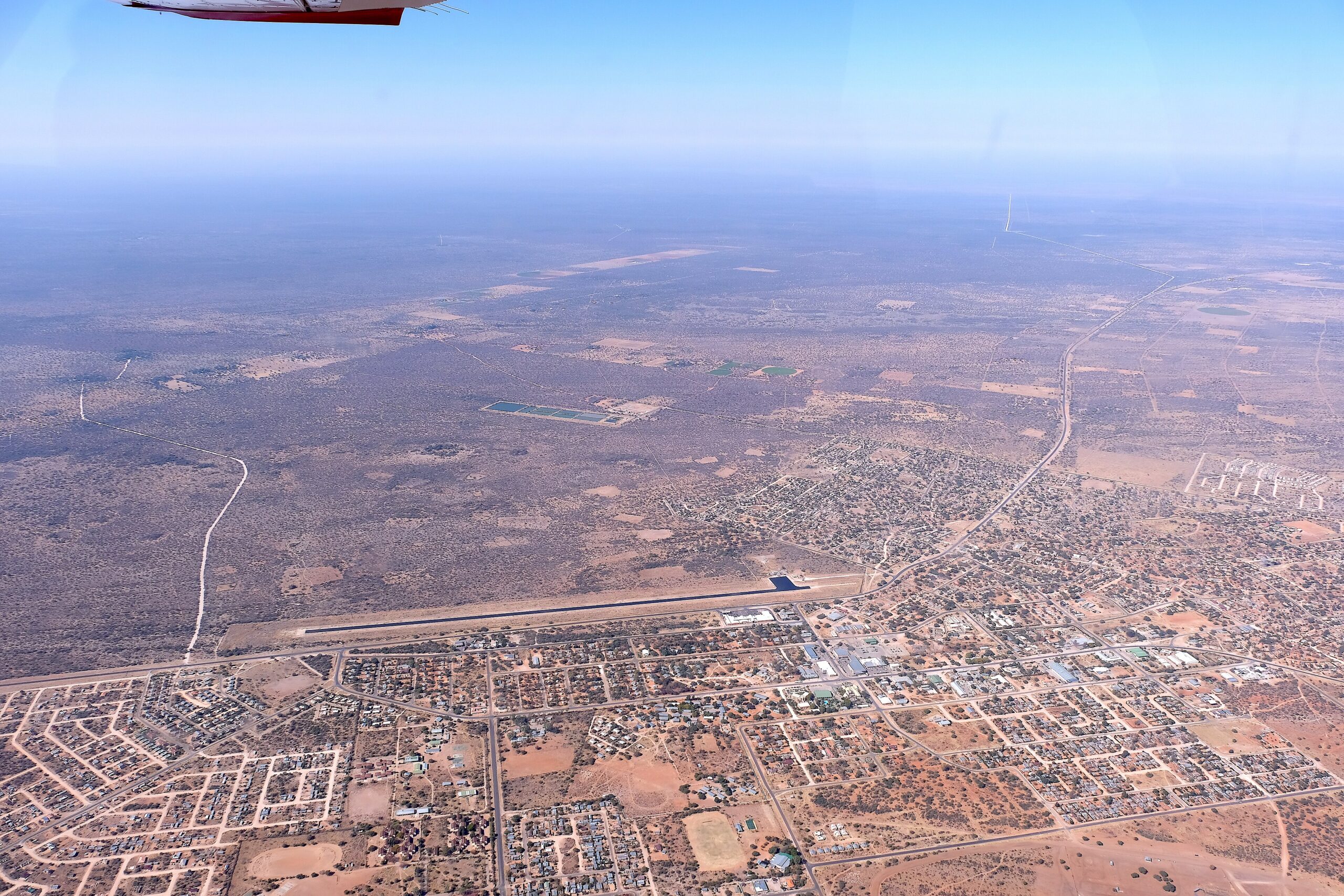
Kalahari regionAll destinationsAerial view of Ghanzi town and its airstrip on the Kalahari, Botswana, photographed in 2018. Photo: Cindy Heppelmann, CC BY-SA 4.0, via Wikimedia Commons.
Ghanzi is the only town of any size in western Botswana, and it exists for two reasons that have nothing to do with tourism: cattle and the road to Namibia. Botswana Tourism promotes it as the Gateway to the Kalahari, which is fair, but the town itself is a working farming centre rather than a safari village, and knowing that before you arrive changes what you get out of it.
- Where
- Western Botswana, on the Trans-Kalahari Highway
- Role
- Cattle-farming hub and the western gateway to the Kalahari
- Roads
- A2 Trans-Kalahari Highway; A3 north-east to Maun, about 325 km
- District
- Over 200 cattle farms (Botswana Tourism Organisation)
- Best for
- A staging night, San cultural tourism, the western approach to the CKGR
- Vehicle
- Tar to town; 4×4 for everything beyond it
In this guide
- Where Ghanzi is, and what it is for
- The cattle district
- Who lives here
- San cultural tourism, honestly
- Getting there and onward routes
- Ghanzi and the Central Kalahari
- Where to stay, and how long
- Best time to visit Ghanzi
Where Ghanzi is, and what it is for
Ghanzi sits in the western portion of the country, near the fork where the Trans-Kalahari Highway divides traffic between Gaborone, Maun and Namibia. Botswana Tourism calls it the Gateway to the Kalahari on exactly that basis: it is where the road system commits you to a direction.
For a traveller this makes Ghanzi a staging town. It is where you sleep before a long day, where you buy what you forgot, and where the tar stops being a formality. It is not a place people come to for a week, and the guide that pretends otherwise is selling you something.
The cattle district
The Ghanzi district holds over 200 cattle farms and is Botswana’s cattle-farming hub. Botswana Tourism describes it as some of the best cattle ranging land globally, renowned for high-quality free-range beef, and records that Ghanzi farmers provide 75 per cent of the beef the Botswana Meat Commission exports, principally to the United Kingdom and the European Union.
Those figures explain the landscape you drive through. The fencing, the boreholes, the trucks and the sheer amount of land under management are not incidental to the Kalahari here — they are the working economy of it, and they are one of the reasons the Central Kalahari boundary matters so much a little further east.
Who lives here
Botswana Tourism describes the district’s population as including the San and Bakgalagadi, whom it names as the original inhabitants, together with the Herero, the Batawana and Afrikaners, most of whom first settled in the area in the late 1800s.
The language figures make the point more sharply than any description: Sesarwa is the most commonly spoken language at around a third, followed by Shekgalagadi at about 30 per cent, Setswana at about 21 per cent and Herero at about 10 per cent. Ghanzi is one of the few places in Botswana where Setswana is not the majority language.
San cultural tourism, honestly
Ghanzi is the main centre for San cultural tourism in Botswana. Botswana Tourism lists desert walks with San guides sharing their knowledge of the land, and at D’Kar, 35 km north of town, the annual Kuru Traditional Dance and Music Festival is held each August.
Craft buying is part of the same economy. The tourism authority describes authentic San arts and crafts available locally: ostrich eggshell jewellery and belts, hunting sets, fire sticks, leather items, carvings and traditional musical instruments.
Two things are worth saying plainly. The first is that a guided walk led by people explaining their own country is a genuinely good way to spend a morning, and the knowledge on display — tracking, plants, water — is real expertise rather than performance. The second is that cultural tourism in this region sits inside a long and contested history, and a visitor should not mistake a well-run walk for the whole story. Ask who runs the operation and where the money goes; the good ones will tell you without being pushed.
Getting there and onward routes
The A2, the Trans-Kalahari Highway, runs roughly 762 km from the Mamuno border with Namibia to Pioneer Gate on the South African side, via Ghanzi, Jwaneng, Kanye and Lobatse. It is the main Pretoria–Windhoek corridor and it is the reason Ghanzi sees traffic at all. It is tar, but condition varies and potholes have been flagged as a hazard.
Ghanzi also connects to Maun on the A3, about 325 km north-east. Between them, those two roads make the town a natural overnight for anyone crossing to or from Namibia, or linking the delta to the south.
Tar does not mean easy on the A2. Long distances between settlements, livestock on the road and variable surface condition are the real hazards here, and driving it after dark is the mistake visitors most often regret.
Ghanzi and the Central Kalahari
Botswana Tourism lists excursions to the Central Kalahari Game Reserve among the things Ghanzi offers, and the town is the practical western base for them. The reserve’s Xade gate lies on that side, away from the Matswere gate most northern itineraries use.
This is worth understanding before you book. The Central Kalahari is 52,800 km² with gates on opposite sides, so the choice of approach effectively chooses your trip. Coming from Ghanzi is a different journey from coming from Maun, and neither is a detour from the other. We set the reserve out in full on Central Kalahari Game Reserve.
Where to stay, and how long
Ghanzi’s bed stock is guest farms and roadside lodges rather than town hotels, with several running a campsite on the same plot.
Botswana Tourism describes accommodation in the area ranging from up-market rondavels and chalets to traditional grass huts with modern amenities, much of it on game ranches and farms outside the town rather than in it.
We publish no rates, no availability and no ratings of our own; what we can tell you is what a property is and where it sits. Start at accommodation in Botswana.
One night is the honest answer for most itineraries. Two if you are doing a guided walk properly, or if you are timing a visit around the Kuru festival in August, which is the one week of the year when Ghanzi is a destination rather than a staging post.
Where to stay
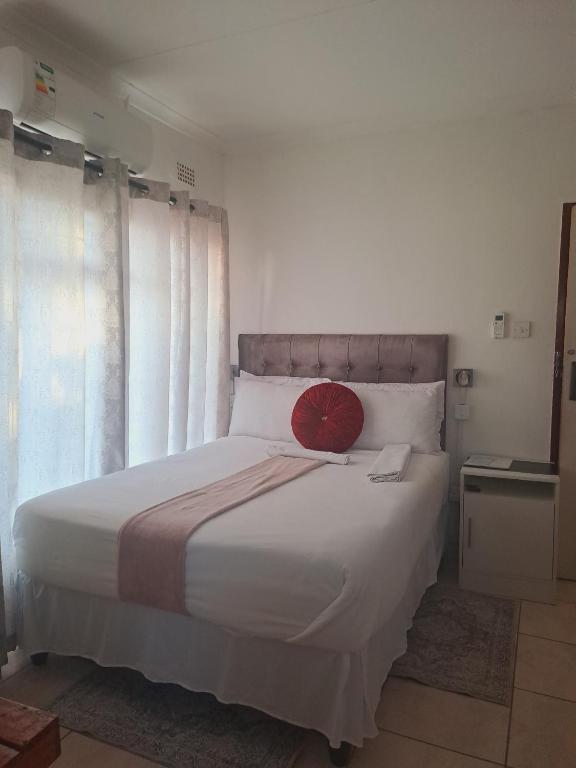
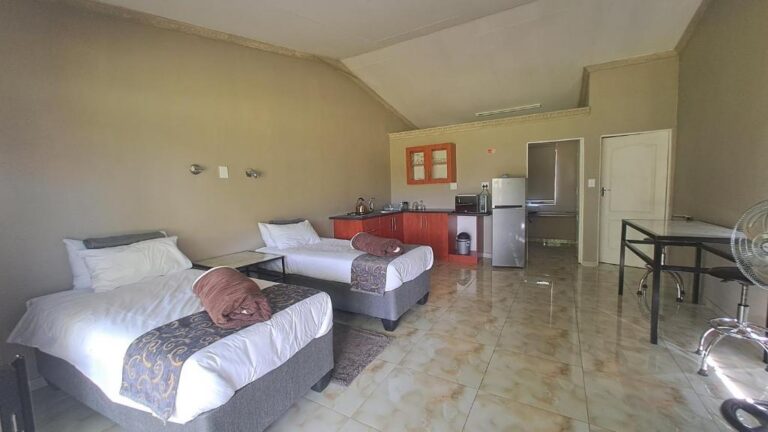
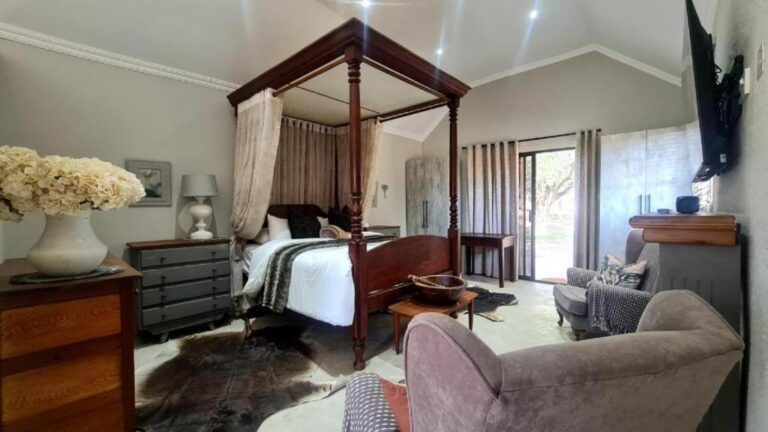
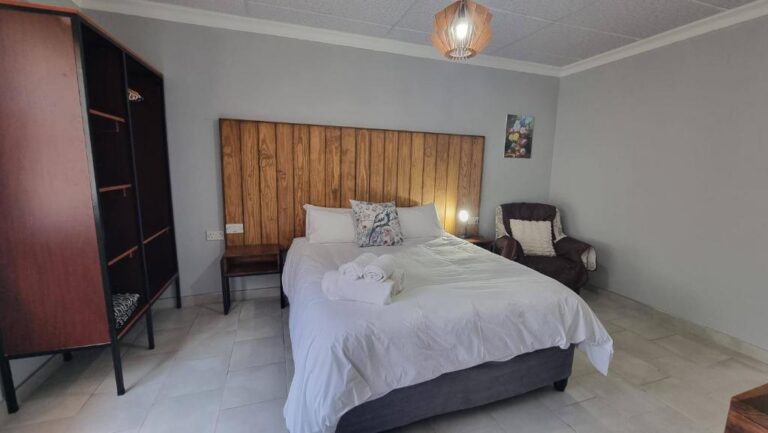
View all 16 Ghanzi propertiesAll Ghanzi and Kalahari accommodation
Every card opens our own property page first. We publish no rates, no availability and no ratings of our own.
View all accommodation in Ghanzi — 16 properties in the town and on its approaches. For the wider region, including Kang and the Kalahari lodges, see accommodation across Ghanzi and the Kalahari — 20 properties we have checked.
Best time to visit Ghanzi
As a staging town, Ghanzi works year-round: the roads are tar and the town functions in any season. What changes is everything you would go on to do from it.
The Kalahari itself is at its best in the wet months, when the grass comes and the herds gather — and at its least comfortable, with shade temperatures reaching 38 °C and above and occasionally 44 °C. Winter brings cold nights and frost inland, sparser game and the clearest skies. The August festival sits squarely in the dry season. We set out the trade-offs on best time to visit Botswana.
Sources and references
- Botswana Tourism Organisation — Ghanzi (Gateway to the Kalahari, over 200 cattle farms, BMC export share, communities and languages, San walks and crafts, D’Kar and the Kuru festival, accommodation types)
- Botswana Tourism Organisation — Climate (seasons, temperatures, rainfall distribution)
Reviewed August 2026. Road conditions, festival dates and farm-stay arrangements change; if something here is out of date, tell us.
Where to stay
20 Ghanzi and Kalahari properties are written up in our catalogue, covering the town, the bush just outside it and the Central Kalahari fringe:
The western way in: the Mamuno border, the Trans-Kalahari and the stop at Ghanzi.
Open →In the middle of Ghanzi next to the banks, supermarket and fuel — the standard Trans-Kalahari halt.
Open →Chalets, Meru tents and powered campsites around a floodlit waterhole 3 km out.
Open →Eight chalets on the Central Kalahari fringe, 80 km north-east on sand — 4×4 or fly-in.
Open →See all 20 Ghanzi and Kalahari properties, or use the accommodation finder at the top of any page to search by property name. We publish no rates, no availability and no ratings of our own.
Plan the rest of your trip
Ghanzi is where a Kalahari trip is decided rather than spent. These are the pages that decide it.
The reserve Ghanzi is the western door to, and what the approach costs you.
Open →The KalahariThe wider region, the sand, and how the reserves and towns fit together.
Open →4×4 and vehicle requirementsWhere the tar ends and what the vehicle has to do after it.
Open →A working town, not a safari village.
Ghanzi rewards travellers who arrive knowing what it is. Cattle, a highway, and the best guided walking in the country.
Kalahari regionAll destinationsView all accommodation in Ghanzi — every property we have published there, each with our own write-up before any booking route.